
Omada AX3000 EAP650
4.5Editor score
Cloud Management Included
PoE Plus Support
Five Year Warranty
Explore our expert guide comparing the top commercial wireless router models for 2026, covering performance, security, and scalability for businesses.
Finding the right commercial wireless router is essential for maintaining reliable connectivity in any business environment. Modern networks require robust hardware that can handle multiple devices simultaneously without compromising speed or security.
We evaluated ten top-rated models based on performance metrics, security features, and ease of management. Our analysis focuses on how each router supports scalable business needs and ensures stable internet access for employees and customers alike.
Each selection below highlights key strengths and ideal use cases for different business sizes. Please note that product availability and pricing can change frequently, so verify current details before making a final purchase decision.
4.5Editor score
4.2Editor score

This side-by-side comparison highlights the core specifications of each model to help you identify the best fit for your specific network requirements and budget constraints.




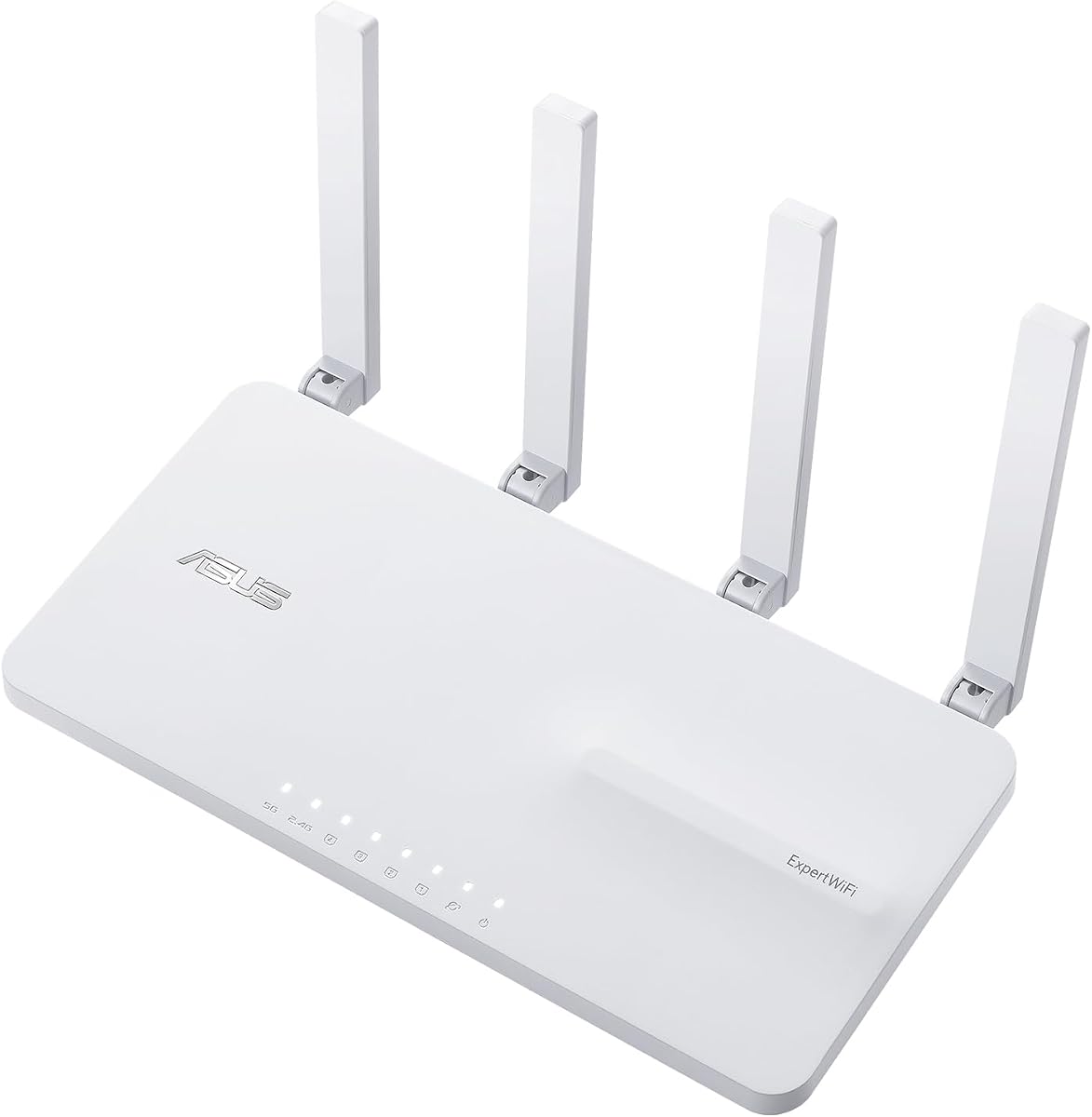
The ASUS ExpertWiFi EBR63 stands out as a top choice for businesses needing reliable WiFi 6 performance. With a 4.2 rating, it balances ease of use and advanced features effectively for small to medium enterprises.
We may earn a commission when you buy through this link, at no additional cost to you.
Its ability to create up to five SSIDs allows businesses to separate guest traffic from internal operations seamlessly. The customizable guest portal enhances brand visibility, while free AiProtection Pro ensures robust security without extra costs.
While setup may require creating an account, the remote management capabilities justify the initial step. The USB backup WAN feature provides critical continuity if your primary connection fails, maintaining business operations without interruption.
This router is ideal for retail stores or offices needing guest access control. Prioritize this model if you value security and manageability alongside high-speed connectivity for your daily business needs.
Customize your guest portal with brand-specific templates to create a professional impression for visitors accessing your network securely.
Enjoy free access to AiProtection Pro for safe browsing and threat protection, safeguarding your business data without additional subscription fees.
We may earn a commission when you buy through this link, at no additional cost to you.
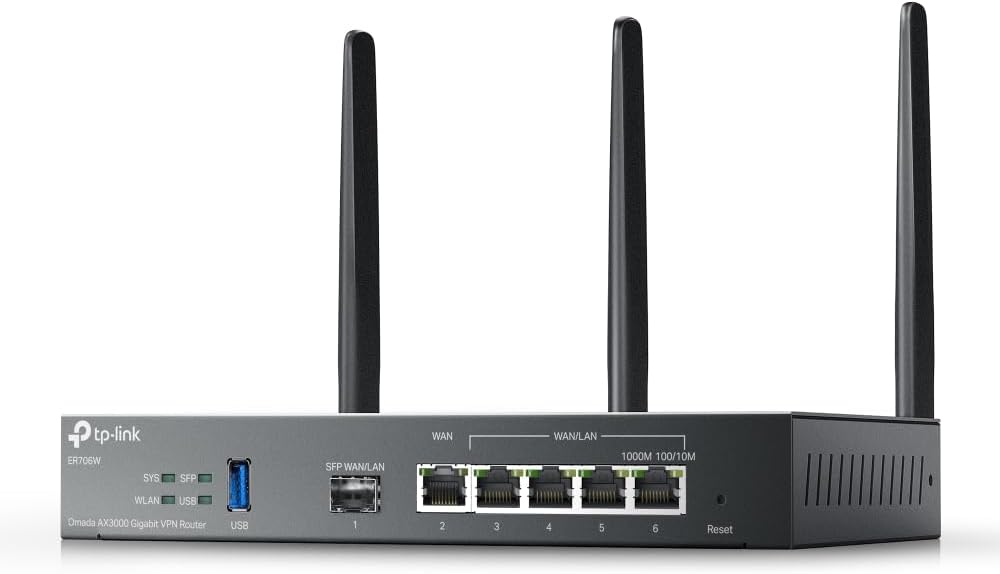
The Omada ER706W is a powerful WiFi 6 router designed for businesses requiring robust WAN flexibility. Its 4.1 rating reflects strong performance in handling complex network needs and security requirements.
We may earn a commission when you buy through this link, at no additional cost to you.
With load balancing across five WAN ports, you can maximize internet efficiency by combining multiple ISP lines. The SFP slot adds fiber connectivity options, making it suitable for high-demand office environments.
Although Omada SDN management can be complex initially, the centralized control offers significant advantages for scaling. It supports multiple VPN protocols including WireGuard and OpenVPN for secure remote access.
Choose this router if you need enterprise-grade routing features at a competitive price. It excels in scenarios where internet redundancy and secure connectivity are critical priorities for your operations.
Utilize up to five WAN ports to balance traffic and ensure continuous connectivity even if one line experiences downtime.
Supports diverse VPN standards like IPsec and L2TP to establish secure tunnels for remote workers accessing sensitive company resources.
We may earn a commission when you buy through this link, at no additional cost to you.
The Ruckus R750 access point is engineered for environments where dozens or hundreds of devices connect simultaneously. Its 4.3 rating highlights reliability in challenging settings like conference centers or busy retail floors.
We may earn a commission when you buy through this link, at no additional cost to you.
Ruckus BeamFlex technology adapts signals dynamically to minimize interference and maximize throughput. This ensures stable connections even when the network is heavily utilized throughout the day.
While it requires a controller for full management, the investment pays off in consistent performance. It is designed specifically for indoor use where coverage precision matters more than raw range.
This access point is best suited for businesses with high-density device usage. Prioritize it if you need to guarantee connectivity quality for customers or employees in crowded spaces.
BeamFlex technology focuses signals directly at connected devices to reduce interference and boost speeds in crowded areas.
Ensure you have a Ruckus controller to manage this AP effectively for best results in large-scale installations.
We may earn a commission when you buy through this link, at no additional cost to you.
The Ruckus R670 delivers cutting-edge Wi-Fi 7 performance for businesses requiring maximum speed and capacity. Although priced higher, it offers unparalleled reliability and future-proofing for modern networks.
We may earn a commission when you buy through this link, at no additional cost to you.
Its 5 GbE port eliminates bottlenecks, allowing full utilization of high-speed internet plans. BeamFlex+ technology further enhances range and signal quality for seamless experiences across large indoor spaces.
Security is reinforced with WPA3 and Dynamic PSK, enabling secure access without a full RADIUS setup. This flexibility is valuable for environments with frequent guest turnover.
Select this premium AP if budget allows and you need top-tier performance. It is ideal for high-end hotels or corporate offices where user experience directly impacts satisfaction.
The 5 GbE Ethernet port ensures wired backhaul does not limit wireless speeds for even the most demanding applications.
Supports simultaneous connections efficiently with six spatial streams, keeping speeds high even as device counts rise.
We may earn a commission when you buy through this link, at no additional cost to you.
The NETGEAR Orbi 970 mesh system provides extensive coverage for large properties or multi-site offices. With a 4.6 rating, it delivers consistent speeds across up to 10,000 square feet without dead zones.
We may earn a commission when you buy through this link, at no additional cost to you.
Quad-Band technology ensures dedicated bandwidth for backhaul, preventing speed drops as more nodes are added. The 10 Gig ports on satellites support high-speed wired connections for stationary devices like PCs.
Setup is guided by the Orbi app, making deployment straightforward even for non-technical users. Security features like Armor provide essential protection against online threats automatically.
Choose this system if you need seamless roaming over a vast area. It is perfect for large office buildings or facilities where reliability and uniform performance are critical requirements.
The dedicated backhaul channel keeps wireless links between nodes fast, ensuring every satellite maintains peak performance.
Multiple 10 Gig Ethernet ports allow direct high-speed connections for devices that benefit from stable wired access.
We may earn a commission when you buy through this link, at no additional cost to you.
The Omada EAP650 offers exceptional value for businesses needing reliable WiFi without enterprise-level costs. Its 4.5 rating reflects strong performance and user-friendly features for small office setups.
We may earn a commission when you buy through this link, at no additional cost to you.
Free cloud management eliminates the need for expensive hardware controllers, reducing total ownership costs. PoE Plus support allows single-cable installation, simplifying deployment in ceilings or walls.
A five-year warranty demonstrates the manufacturer's confidence in product durability. This long-term support is rare in this price range and reduces risk for buyers.
This AP is ideal for startups or small offices on tight budgets. Prioritize it if you need simple, scalable coverage with minimal upfront investment.
Enjoy free cloud management without recurring fees, saving significant money compared to solutions requiring paid software licenses.
PoE capability means you can place units anywhere without worrying about nearby power outlets, streamlining the installation process.
We may earn a commission when you buy through this link, at no additional cost to you.
The Ubiquiti U6+ is a solid choice for businesses integrating into the Unifi ecosystem. Its 4.6 rating indicates strong user satisfaction with its reliability and management features.
We may earn a commission when you buy through this link, at no additional cost to you.
It delivers up to 3 Gbit/s speeds, sufficient for most commercial workloads. The compact wall-mountable design fits discreetly into various office environments without disrupting aesthetics.
While it requires a controller for full functionality, the unified interface simplifies managing multiple network devices. PoE Plus ensures flexible placement without extra power adapters.
Select this AP if you plan to expand your Unifi network over time. It is suitable for small businesses needing professional-grade access points without excessive cost.
Seamlessly integrates with other Unifi switches and controllers for centralized network management and monitoring capabilities.
Its compact form factor allows unobtrusive mounting on walls or ceilings, maintaining a clean professional look.
We may earn a commission when you buy through this link, at no additional cost to you.
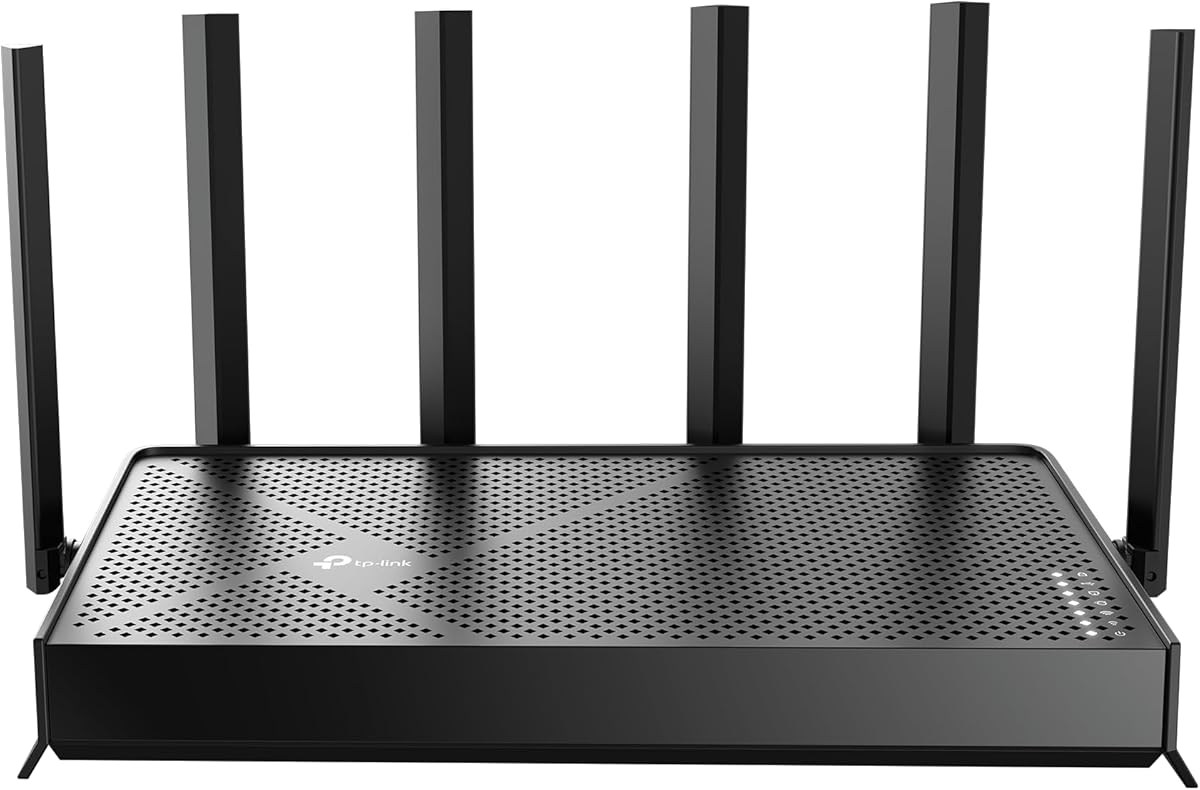
The TP-Link BE6500 brings advanced WiFi 7 technology to businesses at an accessible price point. Its 4.3 rating shows it meets expectations for modern connectivity and performance standards.
We may earn a commission when you buy through this link, at no additional cost to you.
Multi-Link Operation allows simultaneous use of multiple frequency bands, improving throughput and reliability. The 2.5 Gbps WAN port ensures you can fully utilize faster internet plans.
HomeShield provides essential network protection and parental controls. Mesh compatibility lets you expand coverage easily without replacing your existing hardware entirely.
This router is perfect for businesses ready to upgrade to WiFi 7 without overspending. Prioritize it if you need future-ready tech at a reasonable cost.
Multi-Link Operation boosts performance by using multiple bands simultaneously for data transfer and connection stability.
A 2.5 Gbps WAN port unlocks full speed potential from multi-gigabit internet service providers efficiently.
We may earn a commission when you buy through this link, at no additional cost to you.
The NETGEAR Nighthawk WiFi 7 router offers impressive speed for demanding business applications. Its 4.3 rating reflects consistent performance in high-traffic environments like offices or shops.
We may earn a commission when you buy through this link, at no additional cost to you.
With up to 9.3 Gbps across three bands, devices stay fast even under heavy load. Dedicated 2.5 Gig ports ensure wired connections keep pace with wireless demands.
The Nighthawk app simplifies network management, including speed tests and device control. Security features are enabled by default, protecting your network from threats automatically.
Choose this router for high-performance needs without mesh complexity. It is ideal for medium businesses needing a powerful single-node solution.
A dedicated high-speed band handles busy traffic, ensuring other devices remain unaffected during peak usage times.
Multiple 2.5 Gig ports support high-speed connections for critical devices needing stable wired network access.
We may earn a commission when you buy through this link, at no additional cost to you.
The ASUS RT-BE88U delivers exceptional wired and wireless performance for advanced business networks. Its 4.3 rating highlights strong hardware capabilities and robust security features.
We may earn a commission when you buy through this link, at no additional cost to you.
Dual 10G ports provide massive wired capacity for servers or high-speed internet plans. AI WAN detection maintains uptime by switching connections automatically if the primary fails.
AiProtection Pro offers commercial-grade security and site-to-site VPN support. This router integrates smoothly with other ASUS routers via AiMesh for expanded coverage.
This model suits businesses needing maximum connectivity flexibility. Prioritize it if you require multi-gigabit speeds and advanced security for your infrastructure.
Dual 10G ports support ultra-fast data transfers for internal networks and high-speed internet connections.
AI WAN detection automatically switches to backup connections, ensuring business continuity during outages.
We may earn a commission when you buy through this link, at no additional cost to you.
Selecting the right commercial wireless router requires evaluating several key factors to ensure your network meets current and future business needs.
Modern businesses should prioritize WiFi 6 or WiFi 7 routers to support high device counts and fast data rates. WiFi 7 introduces features like Multi-Link Operation which significantly improve throughput and reduce latency for real-time applications.
Look for total bandwidth ratings in Gbps to match your internet plan and internal transfer needs effectively.
Ensure the router supports the number of devices you plan to connect simultaneously. Access points with high capacity maintain stable speeds even when dozens of clients are active at once.
Check for specifications indicating supported device counts or high density capabilities before purchasing.
Security is non-negotiable for commercial networks. Look for routers with built-in firewalls, VPN support, and automatic threat detection systems to protect sensitive business data.
Advanced options like Dynamic PSK can simplify secure guest access without complex infrastructure requirements.
Efficient management tools reduce administrative workload. Cloud-based controllers or mobile apps allow remote monitoring and configuration from anywhere.
Ensure the interface is intuitive enough for your staff to manage daily operations without specialized training.
Choose a system that can grow with your business. Mesh-compatible routers or SDN platforms allow you to add nodes or APs seamlessly as you expand.
Check if the ecosystem supports additional switches and access points for unified network management.
Verify the number and speed of Ethernet ports. Multi-gigabit ports ensure your wired devices do not become bottlenecks for high-speed internet plans.
Consider options like SFP slots if fiber connectivity is required for specific business locations.
A solid warranty indicates product reliability and manufacturer confidence. Look for terms of at least three years to protect your investment against hardware failures.
Check support availability hours and channels to ensure quick resolution of any technical issues.
Balance cost with performance. While premium features justify higher prices, ensure the router delivers tangible value for your specific business operations.
Calculate total cost of ownership including potential subscription fees for advanced security features.
Place your router in a central location away from metal objects and thick walls to optimize signal distribution. Avoid placing it on the floor or inside cabinets where heat may accumulate.
Keep firmware updated through the router's admin interface to ensure security patches are applied promptly. Regular updates often include performance improvements that keep your network running smoothly.
Periodically check connected devices and remove unused entries to maintain network hygiene. Clear logs and restart the router every few months to prevent memory leaks from affecting performance.
A WiFi router connects to your modem and manages traffic between your local network and the internet. An access point extends wireless coverage within an existing network but does not route traffic itself.
While possible, consumer routers lack features like advanced security and multi-user management. Commercial models are built to handle higher device counts and provide better uptime for business operations.
WiFi 7 offers significantly higher speeds and lower latency than previous standards. Future-proofing with this technology ensures your network can support upcoming high-bandwidth applications.
Most commercial models support 50 to 200 devices simultaneously depending on the model. High-density access points can support hundreds of clients effectively.
No, some access points operate in standalone mode or cloud mode without dedicated hardware controllers. Cloud controllers offer remote management flexibility for multi-site deployments.
Yes, a warranty protects your investment against hardware failure. Look for at least three to five years to ensure support during your business's critical growth periods.
Use VLANs to isolate guest traffic from internal networks. Enable separate authentication and set bandwidth limits to prevent guests from impacting core business operations.
MLO allows devices to use multiple frequency bands simultaneously for data transmission. This feature increases throughput and reliability, reducing latency for critical applications.
We explored ten top commercial wireless routers ranging from budget access points to premium WiFi 7 systems. Each option brings unique strengths suited to different business environments and technical needs.
Prioritize security features, device capacity, and scalability when making your final selection. Investing in reliable infrastructure pays dividends in reduced downtime and improved employee productivity.
Remember to verify current product availability and pricing before purchasing. Our recommendations reflect the best options available as of November 2026.