
Askar 71F Flat-Field Telescope
4.9Editor score
Lightweight 2.5kg design
Self-flattened optical train
Versatile visual use
This guide compares the top apochromatic refractors for astrophotography and visual use, highlighting optics, portability, and value for serious astronomers
Apochromatic refractors are prized for their exceptional color correction and sharp imaging capabilities. They eliminate chromatic aberration better than standard achromats, making them ideal for both visual observation and astrophotography. Choosing the right one involves balancing aperture, focal length, and optical quality.
We compared ten top-rated apochromatic refractors based on optical design, build quality, and user feedback. Our analysis focuses on triplet and quadruplet air-spaced designs that minimize color fringing. We also considered portability features and included accessories that enhance their versatility for deep sky imaging.
Each pick below highlights key strengths and ideal use cases for different astronomers. From compact travel scopes to larger aperture models, you will find options suited to various budgets and goals. Remember that availability and pricing can change, so always verify details before purchasing your next telescope.
4.9Editor score

4.5Editor score

The following table provides a quick side-by-side look at the key specifications and features of each apochromatic refractor in our review. This helps you compare aperture, focal ratio, and special features at a glance to find the model that best fits your astronomy needs.




The SVBONY SV550 AP0 is a standout choice for those seeking high performance without excessive bulk. Rated highly by users, its triplet air-spaced design effectively eliminates chromatic aberration, delivering crisp images across the field. This makes it suitable for both visual observing and serious astrophotography.
We may earn a commission when you buy through this link, at no additional cost to you.
Its use of S-FPL51 low-dispersion ED glass ensures that blue-edge aberrations are minimized, resulting in sharper star points. The magnesium alloy dual-speed focuser reduces weight and vignetting, which is particularly beneficial when using full-frame cameras. The internal light barriers further enhance contrast by preventing stray light.
While the scope is compact, it may require additional accessories for a complete imaging setup. The lack of an included dew heater means users should consider one if observing in humid conditions. However, these trade-offs are acceptable given the optical quality and portability.
This telescope is ideal for intermediate to advanced astronomers who value image quality and ease of use. Whether capturing Messier objects or exploring deep sky targets, the SV550 AP0 provides the clarity needed for rewarding sessions under the stars.
The triplet design with ED glass ensures minimal color fringing for sharper details.
Lightweight magnesium components make it easy to carry to dark sky sites.
We may earn a commission when you buy through this link, at no additional cost to you.
The Askar 71F is an excellent entry-level option for budget-conscious astronomers. With its quadruplet air-spaced design, it offers impressive optical performance for its size. The telescope is notably lightweight, weighing only 2.5kg, which makes it highly portable for travel and spontaneous stargazing.
We may earn a commission when you buy through this link, at no additional cost to you.
One of its standout features is the rotatable focus tube, which simplifies camera alignment without needing to rotate the entire tube. The matte paint interior reduces stray light, improving contrast for planetary and lunar viewing. Its self-flattened design makes it easy to use for imaging without extra correctors.
The smaller 71mm aperture limits its ability to gather light compared to larger scopes, which might restrict deep sky observations. However, for planetary and lunar imaging, it performs exceptionally well. The cost-effective pricing makes it a strong value for beginners or as a guide scope.
This model is perfect for those starting their astrophotography journey or needing a portable secondary scope. Its balance of quality, weight, and price ensures it remains a favorite among amateur astronomers looking for reliable performance.
At just 2.5kg, it is easy to transport and set up anywhere.
Self-flattened optics remove the need for additional field flatteners.
We may earn a commission when you buy through this link, at no additional cost to you.
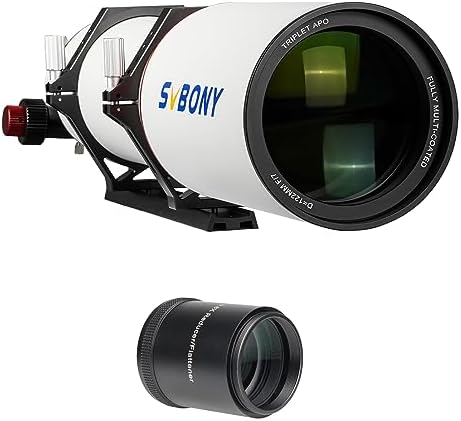
The SVBONY SV550 122mm Kit is a premium choice for serious astrophotographers. Its 122mm aperture gathers significantly more light than smaller models, allowing for detailed imaging of faint deep sky objects. The included focal reducer expands its versatility for wide-field shots.
We may earn a commission when you buy through this link, at no additional cost to you.
This model features a convenient carrying handle and dovetail base, making it easier to transport despite its larger size. The FPL-51 triplet lens structure enhances clarity and sharpness by minimizing chromatic aberration. Users appreciate the balance between power and portability.
The weight and cost are higher than entry-level options, which might be a consideration for budget users. However, the imaging capabilities justify the investment for those focused on deep sky photography. The included accessories streamline setup and use.
Ideal for advanced enthusiasts, this kit delivers professional-quality results for faint nebulae and galaxies. Its design ensures that high performance does not come at the expense of usability or transport convenience.
The 122mm aperture allows for capturing fainter deep sky objects effectively.
The focal reducer improves imaging quality for wider field of view shots.
We may earn a commission when you buy through this link, at no additional cost to you.
This bundle from SVBONY combines the SV550 OTA with a dedicated field flattener, offering a complete solution for astrophotography. The 80mm aperture provides a good balance for deep sky imaging, while the flattener corrects field curvature effectively. It holds a perfect 5.0 rating from satisfied users.
We may earn a commission when you buy through this link, at no additional cost to you.
The magnesium alloy focuser reduces weight and vignetting, improving performance with full-frame cameras. The 45mm large target surface supports various camera formats, making it versatile for different setups. Internal light barriers ensure high contrast images by blocking stray light.
Adding the flattener increases the overall weight, which may affect portability. Users need to ensure proper configuration to achieve optimal results. Despite this, the included accessories save time and effort compared to sourcing parts separately.
For photographers seeking an all-in-one package, this bundle delivers excellent results. It is particularly suited for those targeting Messier objects and bright nebulae with sharp edge-to-edge clarity.
The included flattener corrects field curvature for sharp corner stars.
Supports both half-frame and full-frame sensors for flexibility.
We may earn a commission when you buy through this link, at no additional cost to you.
This kit emphasizes portability without sacrificing aperture. The 122mm scope comes with a dovetail base and carrying handle, making it easier to transport. It is designed for travel, allowing users to set up quickly at dark sky sites.
We may earn a commission when you buy through this link, at no additional cost to you.
The larger aperture enables imaging of fainter deep sky objects than smaller models. The included mount bracket for a guide scope enhances tracking accuracy for long exposures. The FPL-51 triplet lens ensures sharp, aberration-free images.
The weight of the larger scope requires a sturdy mount for stability. Users should account for this when planning their gear. However, the convenience features make it a practical choice for serious observers.
Ideal for travelers who want larger aperture, this kit offers a great balance. It allows for detailed imaging while maintaining enough portability for regular transport and setup.
Handle and base design simplify transport and setup on location.
Mount bracket included for easy integration of guide scopes.
We may earn a commission when you buy through this link, at no additional cost to you.
The SVBONY SV503 offers a robust 102mm aperture for enhanced light gathering. It features FMC coating to improve transmission and reduce reflections. The dual-speed focuser with a 360-degree rotator simplifies precise alignment during imaging.
We may earn a commission when you buy through this link, at no additional cost to you.
Its 90mm focus travel accommodates various accessories like filter wheels. The retractable aluminum hood protects the lens and blocks stray light. S-FPL51 ED glass ensures true-to-life color for planetary and deep sky use.
At 102mm, the scope is heavier than 80mm models, requiring a stable mount. The manual focuser demands patience for critical focus. However, the optical quality compensates for these factors.
This model suits observers wanting more light grasp without moving to larger formats. It is versatile enough for both visual and imaging tasks with excellent detail resolution.
The 102mm size captures more detail for brighter deep sky objects.
Ample focus travel supports complex imaging accessories like filter wheels.
We may earn a commission when you buy through this link, at no additional cost to you.
This bundle combines a 122mm triplet APO with a focal reducer for wide-field imaging. The reducer corrects field curvature and expands the field of view. It is rated highly for its imaging capabilities and clear details.
We may earn a commission when you buy through this link, at no additional cost to you.
The scope features a magnesium alloy focuser and multiple extinction barriers for better contrast. The 122mm aperture allows capturing fainter targets than smaller scopes. The included reducer streamlines the setup for astrophotographers.
The weight with accessories is significant, requiring a solid mount. Users must manage the length added by the reducer. However, the improved imaging quality makes it worthwhile for serious work.
Perfect for deep sky photographers, this bundle simplifies achieving wide-field shots. It delivers sharp stars from center to edge for stunning nebulae and galaxy images.
The focal reducer expands the field for broader deep sky captures.
Flattener ensures stars remain sharp across the entire sensor.
We may earn a commission when you buy through this link, at no additional cost to you.
This kit focuses on portability for the 122mm scope. The handle and dovetail base make it convenient to move and set up. It includes a focal reducer for enhanced imaging performance in the field.
We may earn a commission when you buy through this link, at no additional cost to you.
The triplet ED optics ensure clear and sharp images for deep sky targets. It is designed for travel, fitting into a carrying case easily. The aperture provides good light gathering for faint objects.
The cost is higher than many competitors, which may deter some buyers. Setup requires attention to alignment. However, the travel-friendly design is a significant plus for enthusiasts on the move.
Best for those who travel frequently to dark skies, this kit balances power and transport. It enables detailed imaging without compromising mobility.
Designed to be carried easily to various observing locations.
Included reducer improves edge performance for better wide-field shots.
We may earn a commission when you buy through this link, at no additional cost to you.
This kit includes the SV550 80mm OTA with a field flattener for sharp imaging. The triplet design with S-FPL51 ED glass minimizes aberrations. It features a convenient handle for easy transport to observing sites.
We may earn a commission when you buy through this link, at no additional cost to you.
The ultra-wide band coating reduces reflections for bright, clear images. It is suitable for Messier catalog targets and common shooting targets. The handle improves safety during installation and transport.
The 80mm aperture limits faint deep sky capture compared to larger scopes. Assembly requires some attention to detail. Nevertheless, it is a solid choice for beginners or as a secondary scope.
Ideal for those starting out, this kit provides essential tools for imaging. It offers excellent value with the included flattener for better field performance.
The handle makes carrying and setup safer and more convenient.
Ultra-wide band coatings ensure minimal reflections and maximum contrast.
We may earn a commission when you buy through this link, at no additional cost to you.
This bundle provides everything needed for astrophotography including a guide scope and camera. The 122mm scope offers excellent light gathering. The camera has high QE for sensitive tracking of faint stars.
We may earn a commission when you buy through this link, at no additional cost to you.
The guide scope ensures precise tracking for long exposures. The camera sensor supports autoguiding and planetary imaging well. It is compatible with many mainstream auto-guiding systems.
The cost is high due to the included accessories. Setup requires configuring all components for optimal performance. However, it eliminates the need to buy parts separately.
Best for users wanting a complete turnkey solution, this kit simplifies imaging. It delivers high performance for deep sky and planetary work with reliable tracking.
Includes essential guides and cameras for immediate imaging use.
The camera captures faint stars easily for precise autoguiding.
We may earn a commission when you buy through this link, at no additional cost to you.
Selecting an apochromatic refractor involves considering several key factors that affect performance and usability. This guide outlines the most important aspects to evaluate before making a purchase.
Aperture determines how much light the telescope can gather. Larger apertures like 122mm reveal fainter deep sky objects but add weight and cost. Smaller ones around 80mm are more portable and affordable yet still capable of impressive visuals.
Choose an aperture that balances your light-gathering needs with portability requirements.
Most apochromatic refractors use triplet or quadruplet air-spaced designs to correct chromatic aberration. These designs offer better color correction than doublets. Triplet lenses are standard in this category and deliver sharp results.
Look for air-spaced triplet designs with ED glass for optimal color performance.
Focal ratio affects imaging speed and field of view. Faster ratios like F6 or F6.9 provide wider fields suitable for large nebulae. Slower ratios like F7 offer higher magnification and are better for planetary work.
Consider your primary targets and choose a focal ratio accordingly.
Portability is key if you plan to transport your scope frequently. Weight and size play major roles here. Features like carrying handles and lightweight materials like magnesium help improve mobility.
Opt for lighter scopes with handles if you travel to dark sky sites often.
A good focuser is essential for precise focusing especially with heavy camera gear. Dual-speed focusers allow fine-tuning. Focuseders made of aluminum reduce vignetting compared to plastic ones.
Ensure the focuser matches your imaging load and allows for fine adjustments.
Bundles often include field flatteners or focal reducers that are necessary for imaging. These accessories can save you time and money. Without them, you may face field curvature issues that degrade image quality.
Check if bundles include essential accessories to avoid additional costs.
Build quality affects durability and alignment. Features like internal light barriers reduce stray light. CNC processed barrels ensure precise manufacturing and better resistance to environmental factors.
Prioritize scopes with robust construction and stray light control for better contrast.
Apochromatic refractors range widely in price. Entry-level models offer good value while premium ones provide advanced features. Your budget will largely dictate what you can achieve in terms of aperture and accessories.
Set a realistic budget that covers the telescope and essential imaging gear.
Before each observing session, allow your telescope to acclimate to outdoor temperatures to avoid internal air currents that can blur images. This process is called thermal equilibrium and is crucial for sharp viewing.
Clean the lens gently with a soft brush or air blower to remove dust. Avoid wiping the lens surface directly with cloths as this can scratch the coatings. Store the scope in a dry place to prevent moisture damage.
Regularly check the collimation of your scope to ensure optical elements remain aligned. Use the push-pull adjustments if provided to fine-tune alignment. Proper collimation ensures the best possible image quality and performance.
Yes, apochromatic refractors are excellent for beginners due to their ease of use and minimal maintenance. They deliver clear images with little effort compared to reflectors. A smaller model like 80mm is a great starting point for learning.
ED glass has a lower dispersion rate which reduces color fringing in images. Regular glass often shows more chromatic aberration especially at high magnifications. ED glass helps produce sharper, more accurate colors in your observations.
For most astrophotography with refractors, a field flattener is recommended to correct edge distortions. Without it, stars at the corners may appear elongated. Many bundles now include this accessory for convenience and performance.
Yes, many apochromatic refractors can be used for terrestrial viewing during the day. However, ensure your mount is stable and the optics are clean. You might need an erecting prism for a non-inverted image depending on the setup.
Use an air blower or soft brush to remove dust without touching the surface. For smudges, use a lens solution designed for optics and a microfiber cloth gently. Avoid rubbing hard to prevent scratching the delicate coatings.
Equatorial mounts with adequate weight capacity are ideal for tracking objects smoothly. For visual use, Dobsonian alt-azimuth mounts can work well for larger scopes. Ensure the mount matches your telescope's weight and usage type.
Our selection highlights top apochromatic refractors that balance optical performance with usability. From budget-friendly models to premium kits, there is an option for every level of astronomer seeking clarity.
Prioritize factors like aperture size and portability based on your specific goals. If you want detailed deep sky imaging, larger apertures with accessories are worth the investment.
Always verify availability and pricing before purchase since conditions change regularly. Choosing the right apochromatic refractor will enhance your stargazing and imaging experience for years to come.