
MINISFORUM MS-S1 MAX
4.5Editor score
128GB Unified Memory
Dual Unit Cluster Support
Ryzen AI Max+ 395
This guide compares the top dual GPU AI setups for local inference and training, featuring workstations and mini PCs optimized for large language models and
Dual GPU AI setups are transforming how professionals deploy large language models locally. These systems combine powerful graphics processing units to handle complex inference and training tasks without relying on expensive cloud services. Whether you are a researcher or developer, choosing the right hardware is crucial for performance.
We evaluated ten leading dual GPU configurations ranging from compact mini PCs to enterprise-grade servers. Our analysis focuses on VRAM capacity, compute throughput, software compatibility, and thermal stability under sustained workloads. Each product was selected based on its ability to support modern AI frameworks and open-source models efficiently.
Each entry in this list highlights specific strengths and ideal use cases for different user needs. From budget-friendly clusters to high-end workstations, you will find options tailored to various project scales. Please note that specifications and availability may change, so verify details before purchasing to ensure compatibility with your existing infrastructure.
4.5Editor score


5.0Editor score
This comparison table provides a side-by-side view of the top ten dual GPU AI setups available in October 2026. We have summarized key specifications such as memory capacity, processor type, and storage options to help you quickly identify the system that best matches your computational requirements.


The WEELIAO MAXSUN dual GPU card stands out as a powerful option for local AI inference. It combines two Arc Pro B60 GPUs to deliver a massive 48GB of memory and significant compute power. This design eliminates the need for multi-card setups while maintaining high performance for large language models.
We may earn a commission when you buy through this link, at no additional cost to you.
Its dual GPU compute power allows each unit to operate independently, totaling 394 TOPS for INT8 operations. This architecture is purpose-built for high-concurrency inference and complex workloads. Native support for PyTorch and vLLM makes it easy to integrate into existing workflows without extensive reconfiguration.
While the card offers exceptional value and performance, it requires a motherboard that supports PCIe lane bifurcation to achieve full bandwidth. Additionally, the software ecosystem is growing but may not be as mature as CUDA-based solutions. These trade-offs are acceptable for users prioritizing raw capacity and cost efficiency.
This setup is ideal for researchers and developers who need to run 70B-class quantized models locally. The reliable cooling design ensures stable performance during long inference tasks. If you seek a high-capacity AI workstation component without enterprise costs, this card is a strong recommendation.
With 48GB of unified memory, this setup can handle large quantized models like DeepSeek-R1:70B entirely on a single card. This reduces reliance on cloud services and lowers ongoing operational costs for frequent inference tasks.
Each GPU operates at 2400 MHz with 20 Xe cores, allowing flexible task assignment and efficient handling of multi-turn dialogues. This parallelism ensures that complex AI workloads run smoothly without bottlenecks.
We may earn a commission when you buy through this link, at no additional cost to you.
The APC MES2X is a top-tier workstation designed for demanding AI and machine learning tasks. It features dual NVIDIA RTX PRO 6000 Blackwell GPUs and a powerful AMD Ryzen 9 9950X processor. This configuration delivers exceptional raw power for training and inference workloads.
We may earn a commission when you buy through this link, at no additional cost to you.
With 256GB of DDR5 RAM and dual RTX PRO 6000 GPUs, the system handles large datasets and complex models with ease. The 1600W power supply and liquid cooling ensure the hardware runs smoothly under heavy loads. It comes preloaded with Windows 11 Pro for immediate usability.
While the performance is outstanding, the system consumes significant power and carries a premium price tag. The high power draw may require upgraded electrical infrastructure in some environments. However, for professionals needing enterprise-grade reliability on a desktop, these costs are often justified.
This workstation is best suited for enterprises and researchers requiring maximum throughput. The custom cable management and testing add to its reliability. If budget is less of a concern than performance, the MES2X offers a robust solution for AI development.
The dual RTX PRO 6000 GPUs provide high-end compute capabilities tailored for professional workflows. This allows for faster model training and more accurate results in complex simulations and generative AI tasks.
The 360mm liquid cooler and 1600W power supply keep the system stable during extended operations. This prevents throttling and maintains consistent performance when running intensive AI pipelines.
We may earn a commission when you buy through this link, at no additional cost to you.
The APC ES620 combines consumer-grade graphics with workstation-level support for an effective AI setup. It features dual GeForce RTX 5090 GPUs and a high-core AMD Ryzen 9 9950X processor. This blend offers high performance for local AI deployment at a competitive price point.
We may earn a commission when you buy through this link, at no additional cost to you.
Each RTX 5090 provides 64GB of GDDR7 memory, totaling 128GB of VRAM for large model inference. The 256GB DDR5 RAM and 8TB NVMe SSD ensure fast data access and storage. Liquid cooling on the processor maintains stability during long training sessions.
The system demands significant power with a 1600W supply and requires a spacious tower chassis. Additionally, consumer GPUs may have different driver support compared to professional variants. These factors are acceptable trade-offs for users prioritizing raw compute power.
Ideal for developers and enthusiasts, this workstation balances performance and usability. The turnkey setup reduces the need for assembly. If you need a powerful AI machine without enterprise hardware constraints, the ES620 is a strong candidate.
With two RTX 5090 GPUs, you gain access to 128GB of VRAM. This allows you to run larger models like QwQ-32B or DeepSeek series locally without quantization compromises.
The 8TB NVMe SSD and 256GB DDR5 RAM eliminate bottlenecks in data ingestion. This ensures that models have immediate access to training data, speeding up iteration cycles.
We may earn a commission when you buy through this link, at no additional cost to you.
The NVIDIA DGX Spark 2 Pack brings enterprise-scale AI performance to your desktop. It features the Grace Blackwell architecture, delivering up to 1 petaFLOP of AI performance. This setup is designed for local model fine-tuning and inference with a focus on efficiency.
We may earn a commission when you buy through this link, at no additional cost to you.
Each unit offers 128GB of unified memory, enabling rapid testing and validation of large models. The integrated NVIDIA AI software stack ensures seamless development and deployment. You can experiment with models up to 200 billion parameters directly on your desktop.
The cost of this setup is significant compared to standard workstations. Additionally, its performance depends on adequate cooling and power provision. However, for innovators needing to iterate quickly, the productivity gains can justify the investment.
This product is perfect for teams prototyping AI solutions locally. It offers a secure and high-performance setting for development. If you require supercomputer performance without the data center footprint, the DGX Spark is an excellent choice.
The Grace Blackwell architecture allows you to run large models locally with high efficiency. This reduces dependency on cloud resources and lowers latency for interactive AI applications.
With 128GB of unified memory per unit, data movement between CPU and GPU is minimized. This boosts performance for complex workflows and supports larger batch sizes during training.
We may earn a commission when you buy through this link, at no additional cost to you.
The ASUS Dual EPYC 9965 is an enterprise-level server designed for high-density AI computing. It features two AMD EPYC 9005 processors providing 192 cores and 2.3TB of DDR5 ECC memory. This system is built for clusters and demanding HPC workloads.
We may earn a commission when you buy through this link, at no additional cost to you.
Its 4U chassis supports up to eight GPUs, allowing massive VRAM scaling. The 3200W power supply and advanced networking ensure reliable performance under heavy loads. It includes ASUS Control Center for streamlined IT management and security.
This server requires a dedicated rack and significant electrical capacity. The complexity of setup may be beyond typical desktop environments. However, for organizations needing scalable AI infrastructure, the robustness is invaluable.
Ideal for data centers or research labs, this server delivers unmatched throughput. The toolless design simplifies maintenance tasks. If you need a scalable, secure, and powerful AI backend, this server is the definitive solution.
The 8U support allows you to scale GPU count based on training needs. This modularity ensures your infrastructure can grow with your project requirements without replacing the entire server.
Includes a hardware-level Root-of-Trust solution and advanced management software. This ensures your AI models and data remain secure and managed efficiently in a professional environment.
We may earn a commission when you buy through this link, at no additional cost to you.
The Cloud Ninjas Iron Bull is a specialized workstation optimized for geospatial and AI workflows. It features a 32-core Ryzen Threadripper 9970X and an RTX 5090 GPU with 32GB memory. This setup ensures stability with ECC DDR5 memory for critical processing.
We may earn a commission when you buy through this link, at no additional cost to you.
Its 128GB of ECC memory and fast networking allow seamless handling of large datasets. The system includes a 1600W power supply and liquid cooling to maintain peak performance. It is tailored for specific applications like PIX4Dsurvey and GIS modeling.
The workstation is heavy and requires significant power resources. Its design focuses on a single high-end GPU rather than dual setups. However, for users needing precise error correction and fast data transfer, these specs are essential.
Best for engineers and geospatial analysts, this machine offers specialized efficiency. The robust build quality ensures reliability for critical tasks. If you work with large geographic datasets and require error-correcting memory, this workstation is a top pick.
ECC memory ensures data integrity during long rendering or inference jobs. This prevents errors that could compromise large-scale geographic data analysis and modeling accuracy.
With onboard 10GbE LAN, you can transfer massive datasets quickly. This reduces wait times when loading geospatial files and improves overall workflow efficiency.
We may earn a commission when you buy through this link, at no additional cost to you.
This workstation delivers massive multi-threaded processing and graphics capabilities for local AI training. It features an AMD EPYC 9965 processor with 192 cores and three RTX PRO 6000 GPUs. This setup allows you to handle complex neural networks without cloud latency.
We may earn a commission when you buy through this link, at no additional cost to you.
With 768GB of RAM and three 96GB GPUs, you have 288GB of VRAM available for multi-million polygon assemblies. The 2x4TB Gen5 NVMe SSDs eliminate data bottlenecks. It comes turnkey with Windows 11 Pro for immediate deployment.
The system requires a 240V outlet for maximum capabilities. Its power draw and size may exceed standard office setups. However, for enterprises needing local infrastructure, these factors are manageable trade-offs for performance.
This is a definitive tool for engineering and deep learning workflows. The 3-year warranty and US assembly provide reliability. If you need a powerhouse for AR, CAD, or deep learning, this workstation is unmatched in its class.
768GB of RAM allows you to ingest and parse massive datasets in real-time. This is critical for large-scale data analytics and complex machine learning pipelines.
With three RTX PRO 6000 GPUs, you can parallelize rendering and simulation tasks. This reduces time to solution for complex physics simulations and digital twins.
We may earn a commission when you buy through this link, at no additional cost to you.
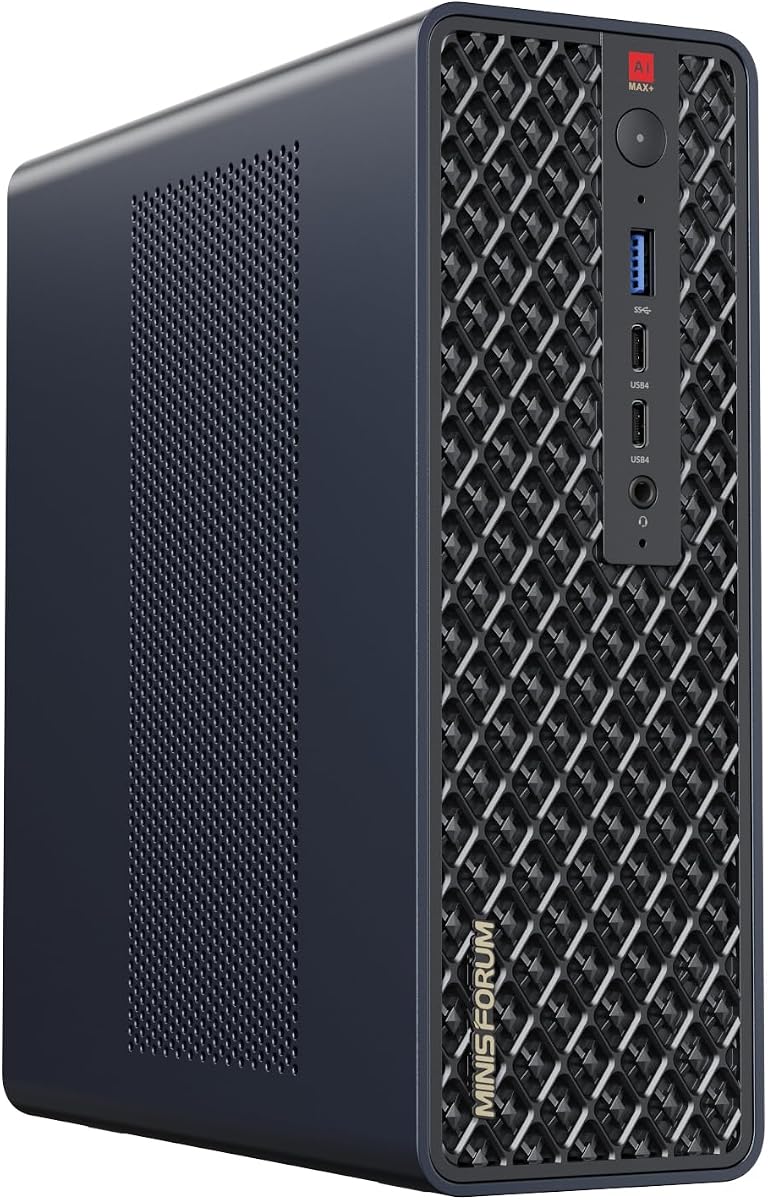
The MINISFORUM MS-S1 MAX brings powerful AI capabilities to a compact mini workstation. It features an AMD Ryzen AI Max+ 395 APU with 128GB of unified memory. This setup supports running large models locally without the footprint of a traditional desktop.
We may earn a commission when you buy through this link, at no additional cost to you.
Its unique cluster design allows two units to run a 235B Q4 model together at over 10 tokens per second. The 128GB memory eliminates VRAM bottlenecks for high-intensity computations. It includes a PCIe x16 slot for flexible expansion.
Single units have limited GPU expansion compared to tower systems. To run extremely large models, you may need to cluster multiple units. However, this trade-off makes it cost-effective and highly efficient for many AI tasks.
This workstation is ideal for studios and personal developers needing flexibility. The cluster interface allows unified management of multiple units. If you want a powerful and compact AI solution that can scale, this is a fantastic choice.
Two units can cascade into a distributed cluster for high-efficiency AI computing. This allows you to scale performance linearly without needing a massive server infrastructure.
128GB of LPDDR5x RAM allows seamless CPU and GPU access. This design maximizes performance stability under high loads and ensures smooth data transfer.
We may earn a commission when you buy through this link, at no additional cost to you.
The NVIDIA RTX PRO 6000 Max-Q offers enterprise-grade performance in a compact dual-slot design. It packs 96GB of GDDR7 ECC memory and delivers up to 3,511 TOPS of AI performance. This card is engineered to eliminate VRAM bottlenecks for local pipelines.
We may earn a commission when you buy through this link, at no additional cost to you.
Its 300W power cap and efficient thermal management make multi-GPU desktop scaling viable. You can handle complex simulations and massive datasets effortlessly. The PCIe 5.0 x16 interface ensures zero-lag multi-stream editing.
The GPU is a premium component and requires a chassis with adequate cooling space. While powerful, it is a single unit rather than a full workstation. However, for teams needing flexible scaling, it offers unmatched reliability.
This card is perfect for independent developers and studios. It bridges the gap between calculation and visual output efficiently. If you require a robust GPU for generative AI and rendering, the Max-Q is an excellent option.
Unmatched thermal management allows multi-GPU desktop scaling without overheating. This ensures consistent performance even when running multiple demanding tasks simultaneously.
The high memory bandwidth supports 8K video content and streaming pipelines. This eliminates lag during real-time encoding and enhances creative workflows for broadcasters.
We may earn a commission when you buy through this link, at no additional cost to you.
The MINISFORUM MS-S1 Max is a versatile mini workstation with strong AI capabilities. It features a 16-core Ryzen AI Max+ 395 processor and Radeon 8060S graphics. This setup provides ultra-high frame rates and advanced content creation features anywhere.
We may earn a commission when you buy through this link, at no additional cost to you.
With 128GB of LPDDR5 memory and five 8K video outputs, it supports multitasking and CAD engineering easily. The dual 10GbE ports and Wi-Fi 7 ensure fast and stable connectivity. It includes phase change cooling for consistent operation.
The compact form factor limits physical expansion options. Thermal dissipation relies on silent fans which may struggle with continuous peak loads. However, for general AI workflows and multimedia, the balance of power and size is impressive.
This mini PC is best for personal desktops or engineering design. It offers five video outputs for multiple monitors and efficient networking. If you need a powerful yet compact solution for creative and AI work, this unit is highly recommended.
With HDMI and USB4 ports, you can connect multiple monitors at once. This improves work efficiency for digital signage and securities trading.
The glacier cooling system with phase change technology ensures stable output. It maintains a quieter operational environment while handling peak power efficiently.
We may earn a commission when you buy through this link, at no additional cost to you.
Selecting the right dual GPU AI setup requires balancing memory capacity, compute power, and thermal efficiency. We have identified key factors to consider to ensure your system meets your specific model training and inference needs.
VRAM determines the size of the models you can run locally without quantization. For large language models like Llama 3 or Qwen, look for setups with at least 64GB of VRAM per GPU. Higher VRAM allows for full precision and larger context windows.
Prioritize systems offering 96GB or 128GB of total VRAM for advanced tasks. This ensures you can host complex models without relying on cloud resources.
Unified memory architectures allow CPUs and GPUs to access a shared pool of memory. This reduces latency and increases bandwidth for large datasets. Systems like the NVIDIA DGX Spark and MINISFORUM MS-S1 use this approach effectively.
Discrete VRAM setups like RTX cards offer dedicated memory for GPU tasks. This is often better for specific graphics-intensive AI workflows and rendering tasks.
The total number of TOPS (Trillions of Operations Per Second) indicates raw AI performance. Look for setups with multiple TOPS to accelerate inference and training. This is critical for high-concurrency dialogues and complex neural networks.
Higher throughput ensures faster results when running local LLMs. Prioritize dual GPU systems with high clock speeds and multiple cores for this metric.
Sustained loads generate significant heat which can lead to throttling. Ensure your setup includes liquid cooling or robust airflow designs. Thermal stability is key for long training sessions and uninterrupted inference tasks.
Systems with high-wattage PSUs and efficient cooling will maintain performance. Avoid compact setups that lack sufficient cooling for continuous operation.
Your GPU must support the frameworks you use such as PyTorch and vLLM. Check for ISV support and open-source compatibility before buying. Native support ensures smooth deployment without custom patches.
CUDA-based systems like NVIDIA have the widest software ecosystem. However, Intel Arc options are growing with strong native support for open models.
Dual GPU setups require significant space and power resources. A 1600W PSU and liquid cooling may require upgraded wiring. Ensure your environment can accommodate the physical size and energy draw.
Compact solutions like mini PCs save space but may limit expandability. Balance your workspace constraints with the need for maximum performance.
Future-proofing is essential for AI workloads that grow in complexity. Look for systems with extra PCIe slots or support for additional storage. This allows you to upgrade memory or add GPUs later without replacing the entire system.
Workstations with modular designs offer the best long-term value. Ensure your choice allows for easy maintenance and component swaps.
Consider energy efficiency and warranty when calculating the total cost. Higher-wattage systems may cost more to run over time. A robust warranty protects your investment against performance failures.
Budget-friendly options like mini clusters can be efficient for specific needs. However, enterprise-grade systems offer reliability that reduces downtime costs.
First, ensure your power supply and electrical outlet meet the system's requirements. High-end workstations often need 240V for maximum capabilities. Verify your setup's power specs to prevent instability.
Second, keep the system clean and well-ventilated. Dust can block airflow and lead to overheating. Regularly clean filters and check fans to maintain thermal efficiency.
Third, update your drivers and BIOS to the latest versions. This ensures compatibility with new models and frameworks. Consistent updates help maintain system reliability.
For most modern large language models, a minimum of 48GB total VRAM is recommended. This allows running 70B-class quantized models locally without major compromises. Higher VRAM ensures better performance for full-precision training.
Yes, dual GPU setups often require motherboard support for PCIe lane bifurcation. This allows full bandwidth for both GPUs. Consumer platforms with x16 bifurcation are ideal for these systems.
Yes, with 96GB or 128GB VRAM you can run multiple instances of local LLMs. Each GPU can handle a separate model or task. This enables parallel inference for multiple users simultaneously.
NVIDIA GPUs currently have broader software support and frameworks. However, newer AMD cards like MI300X are catching up. For local open-source models, both can work well depending on optimization.
A dual GPU workstation typically requires between 1000W and 1600W of power. This ensures stable operation during heavy loads. Always check the specific PSU requirements of your chosen unit.
Liquid cooling helps maintain stable temperatures during long inference tasks. It prevents throttling which can slow down model training. For sustained loads, liquid cooling is highly recommended.
We have reviewed ten top dual GPU AI setups ranging from compact mini PCs to powerful enterprise servers. The WEELIAO MAXSUN card and NVIDIA DGX Spark 2 Pack stood out for their specific performance and efficiency. Each option offers a unique balance of capacity and usability.
When choosing a system, prioritize VRAM capacity and thermal stability for your workload. Ensure your power and space environment can support the setup's demands. Investing in the right hardware ensures long-term value for your AI projects.
Remember to check current prices and availability before making a decision. Specifications may vary by region and time. Verify the latest details to ensure compatibility with your needs.