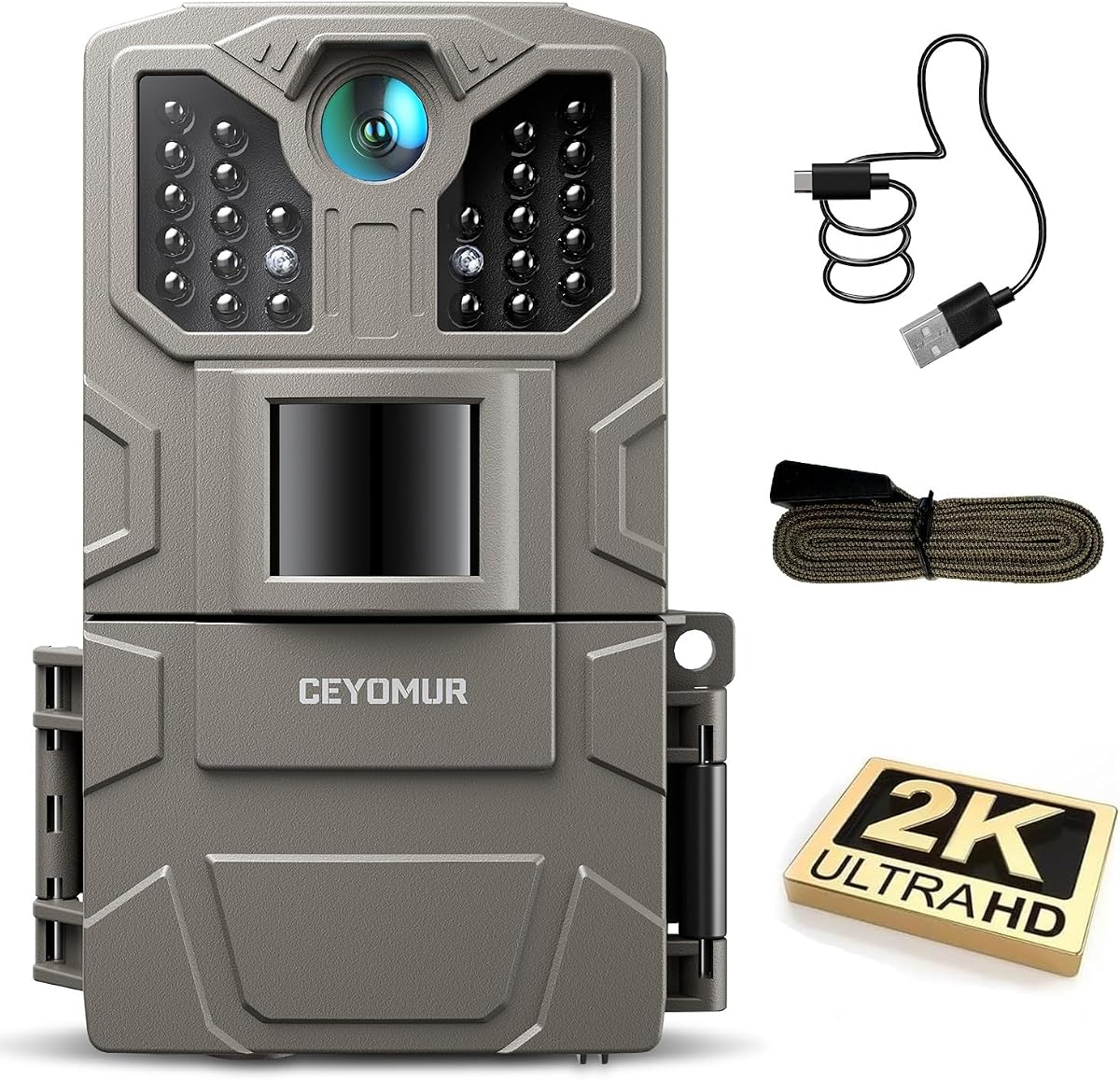
CEYOMUR Trail Camera
4.0Editor score
Low power consumption design
Integrated side controls layout
850nm infrared night vision
This guide compares the best battery life trail camera options for 2026, analyzing power efficiency, solar compatibility, and endurance for outdoor monitoring
Finding a trail camera with exceptional battery life is crucial for remote monitoring without frequent visits. Modern models offer diverse power solutions ranging from standard AA cells to integrated solar charging systems designed for long-term deployment in harsh environments.
We evaluated ten top-rated cameras based on their power consumption efficiency, trigger speeds, and real-world endurance capabilities. Our analysis focuses on how each model handles continuous operation during hunting seasons or wildlife observation periods without compromising image quality or reliability.
Each pick highlights specific strengths in power management and operational versatility for different user needs. Prices and availability fluctuate frequently, so verify current listings before purchasing to ensure you get the best value for your specific outdoor monitoring requirements.
4.0Editor score

4.2Editor score

4.3Editor score
This side-by-side comparison highlights the power specifications and operational capabilities of each model to help you choose the most efficient device for your specific tracking duration and environmental conditions.


The MAXDONE Solar Trail Camera stands out for its built-in solar charging capability combined with a large 6000mAh battery. It offers robust power management that reduces maintenance needs significantly compared to traditional AA battery models.
We may earn a commission when you buy through this link, at no additional cost to you.
This model features a high-efficiency solar panel that works alongside the rechargeable lithium battery to provide uninterrupted power. Users benefit from WiFi and Bluetooth connectivity which allows easy photo viewing without card removal while maintaining low overall power draw.
While the solar panel performs best in direct sunlight, it still provides significant extension of battery life in partially shaded areas. The only trade-off is the lack of cellular options which limits remote access compared to more expensive cellular models.
Hunters and landowners seeking a low-maintenance solution for long-term monitoring will find this camera ideal. Its balance of advanced imaging and sustainable power makes it a top choice for eco-conscious outdoor enthusiasts.
The integrated solar panel ensures continuous operation by recharging the internal battery during daylight hours.
WiFi and Bluetooth connectivity allow users to check footage instantly without physical SD card removal.
We may earn a commission when you buy through this link, at no additional cost to you.
The Moultrie Edge 3 Cellular offers exceptional power management tailored for users who need reliable remote monitoring without physical checks. It supports rechargeable lithium battery packs and solar panels to maximize operational time in the field.
We may earn a commission when you buy through this link, at no additional cost to you.
This camera includes smart battery monitoring features that help users track remaining power levels remotely. The 0.5-second trigger speed ensures quick capture of wildlife movements while the network auto-connect feature simplifies setup significantly.
While the subscription service adds to the total cost, it eliminates the need for constant site visits which saves time and preserves battery life by reducing unnecessary data transmissions. The GPS mapping feature helps optimize camera placement for efficiency.
Serious hunters or large property owners needing constant surveillance will appreciate this model. Its focus on connectivity and power efficiency makes it a premium choice for those willing to invest in cellular infrastructure.
Remotely monitor battery health via the app to prevent unexpected downtime in critical locations.
Compatible with multiple power sources including lithium packs and solar to suit various deployment needs.
We may earn a commission when you buy through this link, at no additional cost to you.
The CEYOMUR Trail Camera delivers solid performance for budget-conscious users seeking reliable battery efficiency. Its design focuses on essential functions that minimize unnecessary power drains while capturing clear images in varied lighting conditions.
We may earn a commission when you buy through this link, at no additional cost to you.
Equipped with 850nm infrared LEDs it provides bright night images without consuming excessive power. The integrated side layout simplifies setup allowing users to adjust settings quickly without repeated power cycles which helps preserve battery health.
While it lacks advanced connectivity features, this simplicity contributes to longer battery life and lower maintenance requirements. The fast trigger speed ensures no moments are missed even if the battery is running low.
Beginners or casual monitors looking for a cost-effective solution will find this camera practical. Its straightforward operation and efficient power usage make it a reliable choice for occasional wildlife tracking.
Fewer complex features mean lower overall power consumption for extended monitoring periods.
Side mounted controls reduce the need for multiple device openings during setup.
We may earn a commission when you buy through this link, at no additional cost to you.
The WOSPORTS Trail Camera balances high resolution imaging with efficient power management to support extended field use. It supports standard AA batteries and offers compatibility with external solar panels for flexible power options.
We may earn a commission when you buy through this link, at no additional cost to you.
With a fast 0.2-second trigger and 120-degree wide angle detection it captures wildlife accurately without missing action. The low-glow night vision ensures clear images while keeping energy consumption manageable even in complete darkness.
Although it relies on standard AA batteries, the optional solar compatibility extends runtime significantly in sunny environments. Users benefit from the 2-inch LCD screen which allows quick previewing without frequent device access.
Those needing high-quality visuals without breaking the budget should consider this model. Its power flexibility and imaging quality make it a versatile choice for both hunting and general wildlife observation.
Supports both standard batteries and external solar panels for adaptable deployment scenarios.
Delivers detailed imagery using efficient processing that minimizes battery drain per shot.
We may earn a commission when you buy through this link, at no additional cost to you.
The Meidase P70 emphasizes power efficiency through H.264 video compression which reduces file sizes and energy usage during recording. It is designed to work with solar panels and standard batteries for sustained operation.
We may earn a commission when you buy through this link, at no additional cost to you.
Its 0.1-second trigger speed ensures immediate capture of wildlife movement which is crucial for fast-moving game. The 100-foot no-glow night vision provides clear night images without disturbing animals or draining excessive power.
While standard AA batteries power the device, the solar-ready feature allows for significant runtime extension in sunny conditions. The compact size helps minimize heat retention which can sometimes affect battery performance in hot weather.
Hunters focused on night time activity will appreciate its balanced power and performance. The efficient video compression ensures longer recording sessions without rapid battery depletion.
H.264 technology reduces file size to save battery during extended video recording.
No-glow LEDs maintain high visibility without excessive power draw or animal disturbance.
We may earn a commission when you buy through this link, at no additional cost to you.
The WOSPORTS Mini Trail Camera uses a compact design that naturally reduces power requirements compared to larger models. It runs on only four AA batteries making it ideal for short term monitoring or areas with limited space.
We may earn a commission when you buy through this link, at no additional cost to you.
Despite its small size it delivers 30MP photos and 1080P HD video which is sufficient for most wildlife tracking tasks. The low-power design ensures that battery life remains consistent even with frequent motion detection triggers.
While it lacks high-end specs like solar compatibility the simplicity of the design keeps energy consumption low. The camouflage finish helps maintain stealth which avoids unnecessary rechecks that waste battery life.
For casual users or those monitoring specific spots briefly this camera offers great value. Its light weight and efficient power use make it easy to manage without heavy maintenance.
Smaller internal components consume less energy allowing longer runtime on fewer batteries.
Camouflage finish reduces animal disturbance and prevents unnecessary camera checks.
We may earn a commission when you buy through this link, at no additional cost to you.
The GardePro E5S offers a reliable non-cellular solution that prioritizes power efficiency and rugged durability. It supports solar panel integration which allows for extended deployment without constant battery swaps.
We may earn a commission when you buy through this link, at no additional cost to you.
With a 0.1-second trigger and 64MP photo capability it captures detailed wildlife activity efficiently. The IP66 waterproof rating ensures it withstands harsh weather without needing internal power for heating or drying components.
While it requires manual SD card retrieval the non-cellular nature reduces constant power drains associated with network connectivity. The large battery capacity ensures long runtime even with frequent motion events.
Outdoor enthusiasts who prefer simplicity over connectivity will find this model effective. Its solar readiness and robust build make it a dependable choice for remote property monitoring.
IP66 waterproof design avoids internal power consumption needed for weather protection.
External solar panels provide renewable power for continuous monitoring in sunny locations.
We may earn a commission when you buy through this link, at no additional cost to you.
The WOSPORTS Mini 2 Pack allows coverage of multiple areas with efficient power usage per unit. Each camera uses just four AA batteries keeping the power requirements low across both devices.
We may earn a commission when you buy through this link, at no additional cost to you.
Designed for simple setup it features 850nm infrared night vision and a 0.3-second trigger that balances speed with energy consumption. The compact design ensures minimal power draw due to smaller internal electronics.
While the bundle includes SD cards for convenience users should note the cameras lack cellular connectivity. This ensures that battery life remains optimized for local storage retrieval rather than constant data transmission.
Users needing broader coverage without high power costs will find this bundle effective. It provides a cost-effective way to monitor multiple points while maintaining manageable battery requirements.
Dual cameras allow monitoring of different zones with low power consumption per unit.
Includes necessary accessories to reduce setup time and avoid additional accessory costs.
We may earn a commission when you buy through this link, at no additional cost to you.
The WOSODA Mini Trail Camera 4 Pack delivers extensive coverage while maintaining low power consumption across all units. Each camera uses only four AA batteries making it easy to manage power for a large network of devices.
We may earn a commission when you buy through this link, at no additional cost to you.
These cameras feature a 0.3-second trigger and efficient night vision that avoids unnecessary battery drain. The included batteries allow immediate deployment without the immediate need for additional power purchases.
The lack of cellular connectivity ensures that each unit focuses solely on capturing images locally which saves significant energy. This makes the bundle ideal for users prioritizing volume of coverage over remote access.
Landowners needing comprehensive property monitoring on a budget will appreciate this setup. The low power requirements per unit make it a sustainable choice for long-term deployment.
Four units allow monitoring of entire properties while keeping total power demand manageable.
Included batteries reduce the initial setup steps and immediate power needs.
We may earn a commission when you buy through this link, at no additional cost to you.
The GardePro E5S 2-Pack provides a balanced solution for users needing multiple high-performance units without high power costs. Each camera supports solar panels and holds eight AA batteries for extended monitoring.
We may earn a commission when you buy through this link, at no additional cost to you.
These cameras offer a 0.1-second trigger and 64MP resolution which requires efficient processing to avoid battery drain. The non-cellular design ensures that power is used primarily for capture rather than constant data transmission.
The ability to use high capacity SD cards allows for more storage without needing to swap memory as frequently. This minimizes the number of times the device needs to be accessed which helps preserve battery life.
Serious monitoring setups requiring high quality imaging at multiple points will find this pair effective. It combines durability with flexible power options to suit various deployment scenarios.
Support for large SD cards reduces the frequency of memory access to save battery.
Dual cameras enable strategic placement to maximize coverage while maintaining individual power efficiency.
We may earn a commission when you buy through this link, at no additional cost to you.
Selecting the right trail camera depends heavily on how long you need it to operate without intervention. Understanding key power factors ensures your investment lasts through the entire season or monitoring period.
Trail cameras typically run on AA batteries, rechargeable lithium packs, or direct solar power. Standard AA batteries are widely available but may need frequent replacement. Rechargeable lithium packs last longer and are more environmentally friendly. Some models allow external battery inputs or solar panels for extended runtime without human intervention.
Choose a camera that matches your accessibility and preference for maintenance.
Faster trigger speeds capture more wildlife action but can consume more power if set to high performance modes. Slower triggers may miss fast movement but extend battery life. Look for cameras with adjustable sensitivity settings to balance capture accuracy with energy efficiency.
Adjust sensitivity based on how active the area is to save power.
Recording video consumes significantly more battery than taking photos. If your goal is primarily tracking movement rather than detailed behavior, opt for photo-only modes. If video is essential, select a camera with efficient codecs like H.264 to reduce file sizes and power drain.
Prioritize photo mode for longer endurance unless video is strictly necessary.
Infrared LEDs come in 850nm (visible glow) and 940nm (no glow). No-glow LEDs save power in some designs but can vary by model. Ensure the night vision range matches your needs so you do not waste energy on unnecessary illumination distance.
Pick a night vision range that covers your target area efficiently.
Solar panels can extend battery life indefinitely in sunny areas. However they require direct sunlight to work effectively. Some cameras have built-in panels while others need external ones. Consider your site's sun exposure before relying on solar to power the device fully.
Use solar if you have consistent sunlight and need zero maintenance.
Cellular cameras use more power than non-cellular ones because they transmit data constantly. If you do not need real-time alerts choose a non-cellular model. This choice alone can significantly increase the time between battery changes in the field.
Avoid cellular models if physical checks are acceptable.
Advanced sleep modes allow cameras to rest when no motion is detected. Cameras with deep sleep capabilities drain less power during idle periods. Look for models that allow you to schedule active times to reduce unnecessary standby usage.
Enable scheduled active periods to conserve energy during inactive hours.
Extreme heat or cold can shorten battery life. Cameras with proper weatherproofing reduce the need for internal heating elements that drain batteries. An IP66 rating ensures the device survives rain and dust without needing extra power for protection.
Choose a camera with high IP rating for consistent battery performance.
Begin by inserting high-quality alkaline or lithium batteries ensuring correct polarity. Fresh batteries prevent voltage drops that can shorten runtime. If using rechargeable packs charge them fully before deployment.
Position the camera facing north to avoid direct sun glare which can trigger false motion events. Secure it firmly to avoid movement in wind which can drain power by activating the sensor unnecessarily.
Regularly check battery levels using any built-in indicators or app features. Replace or recharge batteries when levels drop to avoid gaps in your data collection.
Battery life varies based on activity frequency and settings. Typically expect 3 to 6 months with standard AA batteries if using photo mode. Video mode reduces this time significantly unless you use lithium or rechargeable packs.
Yes many cameras support external solar panels. These provide continuous power in sunny locations. Internal solar cameras also exist but may require direct sunlight for optimal performance and may not work well in dense shade.
Yes lithium batteries generally last longer and perform better in cold weather. They offer higher voltage stability which helps cameras run longer even in extreme temperatures compared to standard alkaline batteries.
Fast battery drain can result from frequent motion triggers or poor placement causing false alerts. Check sensitivity settings and ensure the camera is not facing moving branches or heat sources that cause repeated activation.
Yes infrared LEDs consume additional power during night operation. Cameras with efficient IR circuits manage this better. Limit night capture needs if you want to maximize battery life in dark conditions.
Use high-quality batteries avoid video mode if possible and set cameras to sleep during inactive hours. Regular maintenance to clean lenses and sensors also ensures the camera operates efficiently without extra power usage.
Selecting the right trail camera involves balancing power efficiency with performance needs. Whether you prioritize solar independence or low-cost battery solutions each model offers distinct advantages for different environments.
Focus on key factors like connectivity requirements and video settings to match your monitoring goals. These choices directly impact how often you need to visit your camera site.
Always check current prices and availability before buying since product offerings and costs change frequently. Verify you have enough power sources ready for continuous monitoring when you deploy.