
MikroTik CRS520
4.6Editor score
28 SFP28 ports total
100GbE QSFP28 support
Powerful quad-core ARM CPU
This guide compares the top 25GbE switches with SFP28 ports for enterprise networking, helping you choose the best high-speed network switch for your needs.
High-speed networking demands robust infrastructure capable of handling massive data throughput. 25GbE switches with SFP28 ports offer the perfect balance of speed and cost efficiency for modern data centers and enterprise environments.
We evaluated ten leading models based on port density, switching capacity, management features, and reliability. Our analysis covers both managed and unmanaged options suitable for various professional networking requirements.
Each selection highlights specific strengths like low latency, advanced routing, or budget-friendly pricing. Remember that availability and specifications may vary, so always verify current details before purchasing your network hardware.
4.6Editor score

5.0Editor score

4.8Editor score
The following table provides a side-by-side comparison of all ten switches reviewed in this guide, highlighting their key specifications and capabilities.






This switch stands out as a powerhouse for data center connectivity. It offers unmatched 25GbE connectivity with a robust set of 100GbE uplinks. The high rating reflects its consistent reliability in demanding environments.
We may earn a commission when you buy through this link, at no additional cost to you.
The cut-through switching architecture ensures minimal latency, which is critical for high-performance computing and big data processing. Support for Cisco ACI simplifies network automation and management significantly.
While the renewed condition might concern some buyers, professional inspection ensures functional parity with new units. The complexity of NX-OS requires skilled administrators but provides granular control.
This model is ideal for organizations needing high-density 25GbE access with 100GbE uplinks. Its modular design ensures future-proofing for evolving network requirements without hardware replacement.
The cut-through design reduces latency to under one microsecond, ensuring seamless operation for latency-sensitive applications.
VXLAN support allows efficient creation of scalable, highly available virtual networks easily managed via ACI.
We may earn a commission when you buy through this link, at no additional cost to you.
The CRS520 offers a premium combination of speed and processing power for advanced users. Its massive SFP28 port count supports demanding throughput requirements effortlessly. The hardware configuration reflects top-tier networking capabilities.
We may earn a commission when you buy through this link, at no additional cost to you.
Equipped with a powerful quad-core ARM CPU, this switch handles complex routing tasks without bottlenecks. The 100GbE ports provide flexible uplink options for backbone connectivity in large networks.
The advanced feature set demands technical expertise to configure effectively. Beginners might find the interface less intuitive compared to consumer-grade options.
This switch is perfect for technical teams managing high-performance clusters or large data centers. Its flexibility makes it a long-term investment for growing network infrastructures.
With 28 SFP28 ports, it maximizes server connections within a single rack unit for efficient space utilization.
The quad-core CPU ensures smooth handling of complex routing and switching tasks under heavy load.
We may earn a commission when you buy through this link, at no additional cost to you.
The UniFi Pro Aggregation Switch blends performance with ease of use. It delivers substantial switching capacity and includes essential 25G ports for key uplinks. Its rating highlights strong user satisfaction with management tools.
We may earn a commission when you buy through this link, at no additional cost to you.
The intuitive web application allows remote configuration and monitoring from anywhere. The Layer 3 features enable efficient routing between VLANs without external routers.
With only four 25G ports, access ports are primarily 10G. Users committed to other vendors may find the ecosystem restrictive for broader deployments.
Ideal for small to mid-sized businesses seeking manageable high-speed aggregation. The visual interface and solid performance make it a standout value choice.
The UniFi Network app allows seamless remote monitoring and configuration from any connected device.
Built-in routing capabilities streamline traffic management between segments without extra hardware costs.
We may earn a commission when you buy through this link, at no additional cost to you.
This switch is purpose-built for high-bandwidth NAS deployments and AI clustering workloads. It balances copper and fiber connectivity to bridge legacy and modern infrastructures. Its features ensure lossless performance for storage arrays.
We may earn a commission when you buy through this link, at no additional cost to you.
Advanced technologies like Priority Flow Control minimize packet loss during high utilization. The Layer 3 Lite features support IPv4/IPv6 static routing for efficient segmentation.
The high cost may be prohibitive for general office use. The specific focus on storage workloads makes it less versatile for general IT needs.
Best suited for data centers running intensive virtualization or storage area networks. Its specialized design ensures reliable performance for critical data transmission tasks.
Priority Flow Control and Explicit Congestion Notification minimize packet loss for high-speed transmission.
Designed specifically to handle high-bandwidth NAS deployments and storage area network demands efficiently.
We may earn a commission when you buy through this link, at no additional cost to you.
The PowerSwitch N3224P supports power and data for connected devices effectively. It offers robust uplinks for data center scalability and flexibility. The modular approach allows for easier maintenance and upgrades.
We may earn a commission when you buy through this link, at no additional cost to you.
PoE++ capabilities support high-power devices like PTZ cameras and access points. The modular design ensures the switch can evolve with changing network requirements.
Power consumption is significant compared to lower-end alternatives. Users should ensure adequate cooling and electrical capacity in the server room.
This model is excellent for enterprises integrating 25GbE with legacy 10GbE systems. It balances power delivery and high-speed connectivity in a single chassis.
PoE++ support provides sufficient power for high-demand devices like advanced access points and cameras.
Modular design allows flexible upgrades and maintenance without replacing the entire switch unit.
We may earn a commission when you buy through this link, at no additional cost to you.
This Nexus switch is optimized for cloud computing environments and virtualized workloads. It combines high port density with essential redundancy features for uptime. The renewed status offers significant cost savings on premium hardware.
We may earn a commission when you buy through this link, at no additional cost to you.
Dual AC power supplies ensure continuous operation during power fluctuations. The QSFP+ ports provide flexible connectivity for 40G or 100G uplinks as needed.
Reliance on renewed units means warranty terms may vary by vendor. Budget-sensitive buyers should verify the specific refurbishment process and support coverage.
Best for cloud operators needing dense 25GbE access. Its performance metrics support demanding virtualization and storage workloads effectively.
Dual AC power supplies ensure redundancy and continuous operation even during primary power failures.
Built specifically for cloud computing environments to handle virtualized workloads efficiently.
We may earn a commission when you buy through this link, at no additional cost to you.
This switch serves small to medium businesses needing reliable gigabit performance with web management. It offers lifetime protection and compliance for government projects. The smart features simplify remote diagnostics and configuration.
We may earn a commission when you buy through this link, at no additional cost to you.
Web-based GUI makes configuration accessible for IT staff without deep CLI experience. NDAA compliance ensures suitability for secure government deployments.
Performance ratings suggest some reliability issues compared to premium alternatives. Users requiring complex routing might find the features limiting.
It is a practical choice for basic multi-gig networks. The lifetime protection adds peace of mind for long-term office deployments.
Hive enabled cloud service allows remote management and diagnostics from anywhere with internet access.
Manufacturers stand behind the product with lifetime protection ensuring long-term reliability for users.
We may earn a commission when you buy through this link, at no additional cost to you.
The TEG-S50284 delivers multi-gigabit speeds for offices upgrading from 1G. It offers reliable performance and excellent value for money. Lifetime protection ensures support throughout the product lifespan.
We may earn a commission when you buy through this link, at no additional cost to you.
2.5G ports allow faster throughput over existing Cat5e cabling. The 10G SFP+ ports handle uplinks efficiently without extra cost.
This unit lacks true 25GbE SFP28 ports for modern server connections. Organizations requiring higher bandwidth should look at other options in this list.
It is ideal for general office upgrades needing better speeds without fiber. The high rating reflects consistent performance for SMB networking tasks.
Supports 2.5G speeds over existing Cat5e or better cabling reducing infrastructure upgrade costs.
IEEE 802.1Q VLAN passthrough allows efficient network segmentation and traffic management.
We may earn a commission when you buy through this link, at no additional cost to you.
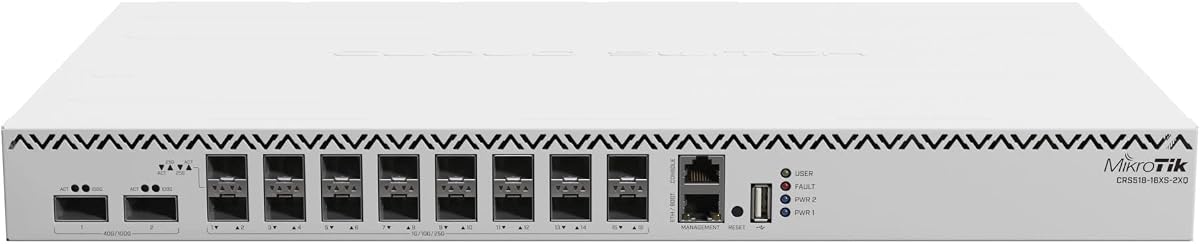
This compact unit packs high-density 25GbE ports into a small form factor. It offers significant value for networks needing fiber connectivity. RouterOS allows deep customization for technical users.
We may earn a commission when you buy through this link, at no additional cost to you.
Sixteen SFP28 ports support extensive server connections in a single unit. The two 100GbE ports ensure scalable uplinks for growing needs.
The CPU and RAM limits may constrain heavy routing tasks. Advanced users will appreciate the flexibility while novices may find it challenging.
Best for environments requiring fiber density on a budget. It balances cost and performance well for small data centers.
Sixteen SFP28 ports in a compact unit maximize fiber connections efficiently for small spaces.
RouterOS provides extensive customization options for technical users managing complex network tasks.
We may earn a commission when you buy through this link, at no additional cost to you.
This switch provides basic smart managed features for small offices and quiet rooms. It includes lifetime warranty support and low power consumption. The fanless design ensures silent operation in sensitive spaces.
We may earn a commission when you buy through this link, at no additional cost to you.
L2+ features like static routing help manage VLANs and traffic flow. NDAA compliance makes it suitable for government installations where security is prioritized.
It lacks 25GbE SFP28 ports for high-speed backhaul connections. Buyers must verify speed requirements before purchasing for modern networks.
Perfect for legacy environments needing reliable management. Its silent and energy-efficient operation suits quiet server rooms.
Fanless design ensures silent operation ideal for noise sensitive office environments and server rooms.
NDAA compliant status makes it suitable for government and high security enterprise projects.
We may earn a commission when you buy through this link, at no additional cost to you.
Selecting the right 25GbE switch involves analyzing your current network needs, budget constraints, and technical expertise.
Determine how many 25GbE and 10GbE ports you need. Some switches offer mixed ports to save costs on legacy devices.
Ensure the switch offers enough high-speed uplinks like 100GbE QSFP28 to prevent bottlenecks.
Managed switches offer VLAN, routing, and security features essential for enterprise environments. Unmanaged units are plug-and-play but lack control.
For security and segmentation, always prioritize managed models with robust web interfaces or CLI access.
Check the total throughput the switch can handle. High switching capacity ensures no data loss during peak usage times.
Non-blocking architecture is critical for high-performance computing and storage networks.
High-speed switches generate heat. Ensure your rack has adequate cooling to prevent thermal throttling.
Consider power consumption for budget planning. Fanless models are quieter but may lack cooling for intensive loads.
Different vendors use proprietary operating systems like Cisco NX-OS or RouterOS. Verify compatibility with your existing management tools.
A familiar interface reduces training time for IT staff managing the network.
Look for modular designs or expandable options. This allows upgrades without replacing the entire hardware unit.
Support for newer standards like RoCEv2 ensures longevity in evolving data center environments.
Reliable support is crucial during outages. Check the terms of lifetime warranties or service agreements.
Premium models often come with better support channels and faster response times.
Begin by connecting your server uplinks to the SFP28 ports using compatible transceivers. Verify optical compatibility before installation to ensure proper link negotiation.
Configure the management interface securely by changing default passwords. Enable VLANs and QoS policies to prioritize critical traffic effectively.
Monitor switch temperature and fan performance regularly. Keep firmware updated to patch security vulnerabilities and improve stability over time.
Yes, SFP28 ports are generally backward compatible with 10G SFP+ modules. This allows you to mix 25G and 10G devices on the same switch without issues.
25GbE provides 2.5 times the bandwidth of 10GbE. It offers higher throughput with similar power consumption, making it efficient for modern data centers.
You need Cat6a or higher copper cables for 25G BASE-T ports. For optical SFP28, ensure your fiber cables match the transceiver type like OM3 or OM4.
Managed switches are recommended for performance tuning and security. They allow control over VLANs and QoS which is vital for high-speed networks.
While possible, excessive stacking increases latency. It is better to use 100GbE uplinks to connect switches directly to the core.
Active cooling is usually required for high-density units. Ensure your rack has enough space and airflow to dissipate heat effectively.
Yes, many switches support mixed speeds like 10G and 25G. Auto-negotiation handles compatibility for most devices and transceivers.
Yes, tools like Nagios or Zabbix work with SNMP to monitor performance. These are useful for custom monitoring setups without vendor software.
We have reviewed ten top switches suitable for various networking needs from SMBs to large data centers. Each offers distinct advantages in speed, management, and budget.
Prioritize throughput and port compatibility when selecting a unit. Ensure the switch aligns with your current and future infrastructure goals.
Always verify current stock and pricing before purchase. Hardware availability changes frequently so check the latest details for your region.