
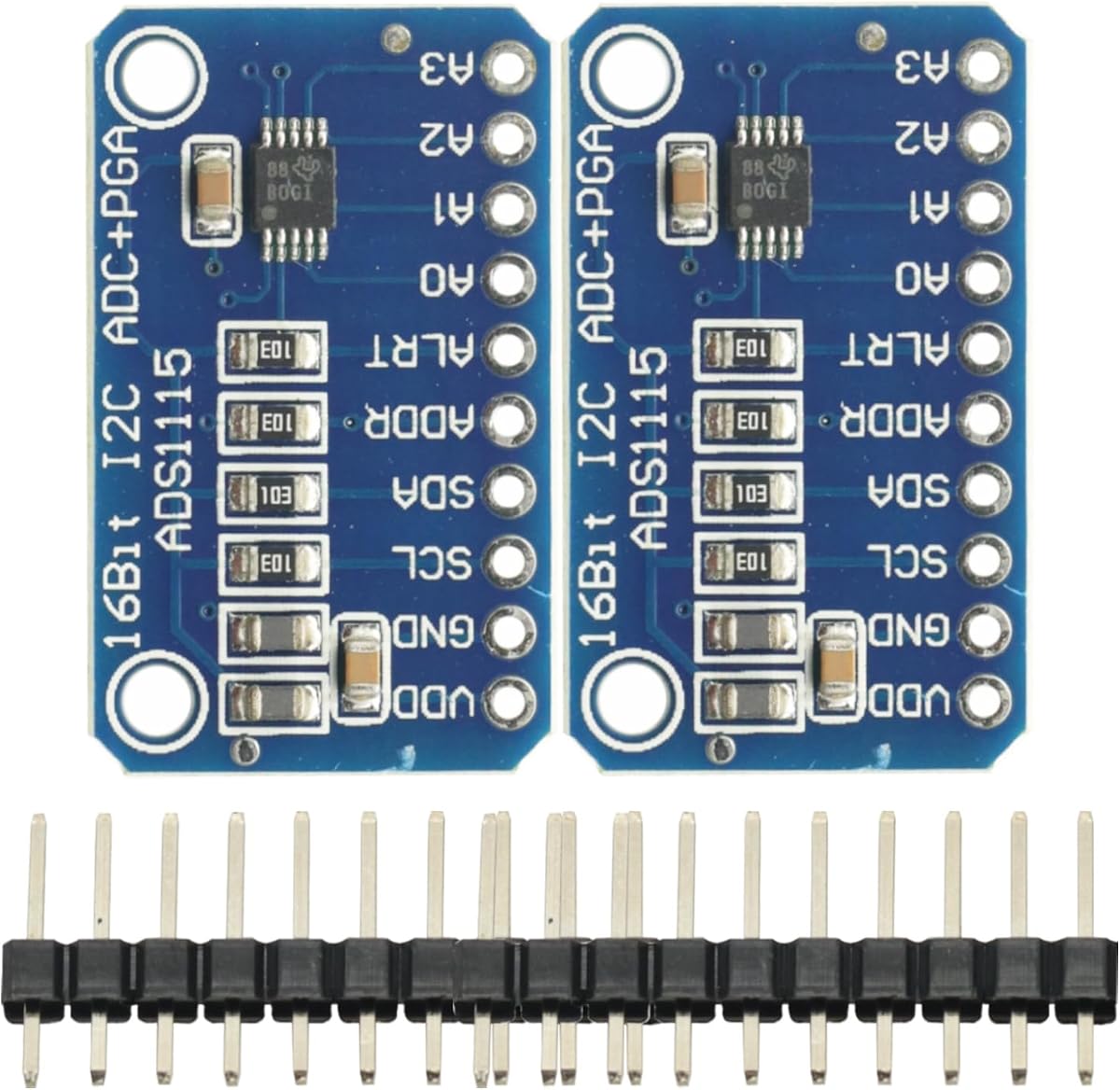
2Pcs ADS1115 16 Bit I2C Module Precision ADC
5.0Editor score
High precision 16 bit resolution
Four channel analog input support
Wide voltage supply range
This guide compares the top Arduino ADC board options for high precision analog sampling to help makers select the right module for their embedded projects.
Arduino boards lack native analog inputs for high precision tasks so external ADC boards bridge this gap. They convert continuous signals into digital data for accurate sensing and control in electronics.
We compared ten popular boards using resolution speed interface type and build quality. Each product offers distinct advantages for different applications ranging from simple sensors to industrial data logging.
Each pick shows key specs strengths and trade-offs to help you decide. Remember that availability and shipping terms vary by region and time so verify details before ordering your next component.
5.0Editor score

4.7Editor score

4.4Editor score
The following table presents a side by side overview of the ten selected ADC boards. It highlights key specifications to help you quickly identify which module fits your project requirements.




This pack offers three ADS1115 modules known for high precision analog conversion. The boards feature 16 bit resolution and four analog input channels suitable for diverse sensor applications.
We may earn a commission when you buy through this link, at no additional cost to you.
Each module includes a programmable gain amplifier to handle low voltage signals. The wide supply range allows compatibility with both 3.3V and 5V logic levels found on most Arduino boards.
While the performance is solid the boards require external headers for breadboard use. This is a minor trade-off given the accuracy and flexibility provided for data acquisition projects.
Makers building multi sensor networks will benefit from getting three units. The consistent quality and reliable communication make it a top choice for educational or prototype phases.
The 16 bit resolution ensures minute voltage changes are captured accurately. This is vital for precision sensors like thermocouples or load cells.
Support for input ranges up to 6.144V allows measuring signals beyond standard logic levels. This flexibility simplifies interfacing with industrial sensors.
We may earn a commission when you buy through this link, at no additional cost to you.
This module stands out with 24 bit resolution ideal for very high precision measurements. It supports up to eight analog channels which is significant for multi sensor data logging.
We may earn a commission when you buy through this link, at no additional cost to you.
The onboard ADS1256 chip provides stable conversion rates and low noise. SPI communication allows faster data throughput compared to standard I2C options available on similar boards.
Setting up SPI on some microcontrollers can be more involved than I2C. However the extra resolution and channel count justify the added complexity for advanced users.
If you need to measure microvolt changes across many sensors this board is suitable. It serves well in applications like scientific instruments or detailed environmental monitoring.
With 24 bit precision this board detects extremely small signal variations. This capability is unmatched by standard 16 bit ADC modules.
Eight channels allow monitoring multiple inputs without multiplexers. This reduces external components and potential signal interference sources.
We may earn a commission when you buy through this link, at no additional cost to you.
This two pack provides excellent value for those needing reliable analog conversion without high cost. The modules feature 16 bit resolution and support for four input channels.
We may earn a commission when you buy through this link, at no additional cost to you.
Users appreciate the easy integration with microcontrollers using just two wires. The programmable gain amplifier helps amplify weak signals from sensors like pH probes.
While it lacks the speed of SPI boards the I2C simplicity reduces wiring errors. The high rating reflects consistent performance across many user projects and reviews.
For hobbyists or classroom settings this pack is an ideal starting point. It balances affordability with the features necessary for most standard data acquisition tasks.
Buying in a pack of two lowers the cost per unit significantly. This allows for redundancy or testing multiple setups simultaneously.
The I2C interface simplifies connections to the Arduino or Raspberry Pi. This reduces clutter and improves project reliability.
We may earn a commission when you buy through this link, at no additional cost to you.
This package offers three identical modules providing ample supply for large projects. Each board delivers consistent performance with 16 bit resolution and four analog inputs.
We may earn a commission when you buy through this link, at no additional cost to you.
The built-in programmable gain amplifier allows flexible signal conditioning. Users can configure the board for different input ranges to match specific sensor outputs.
While slightly rated lower than top picks it remains a reliable option for bulk needs. The comparator mode adds a layer of utility for threshold detection tasks.
It works well with Raspberry Pi systems that lack native analog pins. This makes it a versatile choice for cross-platform projects requiring analog data collection.
Getting three units ensures you have spares for future builds. This reduces downtime if one module is damaged or needed elsewhere.
Designed to complement Pi hardware lacking analog GPIOs. The I2C connection fits naturally into Pi expansion setups.
We may earn a commission when you buy through this link, at no additional cost to you.
For projects needing many analog channels this pack offers four modules at a reasonable cost. Each board provides four channels and high precision 16 bit conversion.
We may earn a commission when you buy through this link, at no additional cost to you.
The internal oscillator ensures stable sampling rates without external components. Auto shut down features help manage power consumption in battery powered systems.
While the packaging is basic the core functionality remains solid for industrial use. The ability to chain multiple boards expands channel capacity significantly.
This kit suits large scale deployments where having multiple units is critical. It eliminates the need to source individual modules for every new project node.
Auto shut down modes reduce idle power draw. This extends battery life in remote sensor nodes.
Connecting four boards allows up to sixteen analog channels. This supports complex monitoring systems without complex multiplexing.
We may earn a commission when you buy through this link, at no additional cost to you.
This two pack maintains a perfect user rating reflecting consistent quality and performance. The modules are compact yet deliver full 16 bit resolution capabilities.
We may earn a commission when you buy through this link, at no additional cost to you.
Programmable gain and multiple input ranges allow adaptability to different sensors. This flexibility ensures accurate readings whether measuring small or large voltage swings.
Despite the low cost the boards do not compromise on accuracy. Users find them reliable for both prototyping and final product integrations.
The perfect rating suggests high satisfaction among diverse user groups. It is a safe choice for anyone needing a dependable analog to digital solution.
A perfect score indicates reliable manufacturing across batches. This consistency reduces variability between units in a project.
Multiple ranges allow measuring different signal strengths accurately. This reduces the need for external voltage dividers.
We may earn a commission when you buy through this link, at no additional cost to you.
This pack features premium ENIG gold plating for superior solderability and durability. The design supports a wide range of microcontrollers including ESP32 and STM32.
We may earn a commission when you buy through this link, at no additional cost to you.
Open source libraries simplify integration for C++ and Python developers. This reduces development time and ensures compatibility with modern embedded ecosystems.
The higher cost reflects better materials and community support resources. It is ideal for long term projects where reliability and maintainability are priorities.
Educational and professional teams will appreciate the robust build quality. The gold finish also resists oxidation ensuring connections remain reliable over time.
ENIG plating improves connection longevity and resistance. This prevents degradation in humid environments.
Open source libraries facilitate easier coding. This benefits users who prefer documented codebases.
We may earn a commission when you buy through this link, at no additional cost to you.
This module distinguishes itself with a 200kHz sampling rate suitable for dynamic signals. All eight channels can sample simultaneously ensuring accurate waveform reconstruction.
We may earn a commission when you buy through this link, at no additional cost to you.
The wide input range of ±10V allows direct interfacing with industrial voltage levels. This eliminates the need for external signal conditioning for high voltage inputs.
However the lower rating suggests potential challenges with usability or support. Users must be comfortable with complex SPI configurations to utilize it effectively.
For audio or vibration analysis this speed is advantageous. It caters to specialized engineering tasks rather than simple hobbyist sensor reading.
200kHz sampling captures fast changing signals accurately. This is essential for audio or frequency analysis.
Support for ±10V allows direct connection to industrial sensors. This simplifies wiring for heavy duty applications.
We may earn a commission when you buy through this link, at no additional cost to you.
This pack offers four modules known for stable and consistent readings over time. Users report reliable performance in both static and dynamic environments.
We may earn a commission when you buy through this link, at no additional cost to you.
Compatibility with various microcontrollers simplifies deployment. Whether using Arduino ESP32 or Raspberry Pi integration is straightforward.
While it lacks unique features the steady performance makes it dependable. It serves well in production environments where consistency is more critical than novelty.
The high rating reflects trust built through consistent delivery. It is a safe choice for scaling up analog monitoring across multiple nodes.
Stable readings reduce noise in long term data. This improves the quality of collected datasets.
Compatible with many popular boards. This reduces dependency on specific hardware ecosystems.
We may earn a commission when you buy through this link, at no additional cost to you.
A classic option this board provides high precision ADC performance for standard needs. It features a 16 bit converter with programmable gain amplification.
We may earn a commission when you buy through this link, at no additional cost to you.
The wide voltage range ensures flexibility across different power sources. Users appreciate the reliable performance and ease of setup.
While sold individually it remains a staple in many maker kits. Its proven track record makes it a safe choice for general applications.
For anyone needing a reliable ADC without special requirements this board works well. It continues to be a preferred choice for many hobbyists and educators.
Decades of use validate its reliability. This reduces risk in critical projects.
Programmable gain allows optimizing sensitivity. This improves accuracy for small signals.
We may earn a commission when you buy through this link, at no additional cost to you.
Choosing the right ADC board depends on resolution needs input channels and communication requirements. Understanding these factors helps match the module to your specific project demands.
Resolution determines how finely analog voltages are converted into digital values. Higher bit counts like 24-bit detect smaller changes but often cost more and require more processing power.
For most sensor projects 16-bit resolution provides sufficient accuracy and balances cost well.
Count the number of sensors you need to read simultaneously. Boards with more channels allow reading multiple inputs without multiplexers or complex wiring solutions.
Ensure the board supports both single ended and differential inputs if required by your sensors.
I2C is simple and uses fewer wires but may be slower than SPI. SPI offers faster data transfer but requires more pins and slightly more complex setup.
Choose I2C for general sensing and SPI for high speed data acquisition applications.
Check that the board accepts the voltage levels your Arduino or Raspberry Pi outputs. Some boards only work with 5V logic while others support 3.3V systems.
Always verify logic tolerance to avoid damaging your microcontroller or the ADC module.
An internal programmable gain amplifier allows amplifying weak signals before conversion. This improves accuracy for sensors with small output ranges.
Select boards with adjustable gain if you plan to use low voltage sensors.
Sampling rate affects how fast the board can convert analog signals. Higher rates are needed for capturing rapidly changing signals like audio or vibration data.
For stable readings like temperature or humidity standard rates are usually adequate and sufficient.
Durability matters for projects that will be used over long periods. Look for boards with quality plating and robust connectors to ensure stable connections.
Premium finishes like gold plating prevent oxidation in humid environments.
Consider buying multi-packs if you need multiple channels or backups. This often reduces the cost per unit and ensures you have spares.
Bulk kits are practical for classrooms or large scale sensor networks.
Connect the VCC and GND pins to your microcontroller power and ground first. Ensure the voltage matches the board requirements to prevent damage during setup.
Wire the SDA and SCL pins for I2C or MOSI MISO SCK for SPI communication. Proper wiring ensures reliable data transfer between the ADC and your code.
Keep the board clean and dry to maintain performance. Protecting it from dust and moisture extends its lifespan and ensures accurate readings.
An Arduino ADC board converts analog signals from sensors into digital data that the Arduino can process. It is essential for measuring voltage, current, or other analog inputs not handled by the main board.
Most ADC boards use I2C or SPI interfaces. Connect the data and clock pins to corresponding pins on the Arduino and provide power to VCC and ground to GND to establish communication.
16-bit resolution is generally sufficient for most hobbyist and industrial sensor projects. It provides accurate readings without the complexity and cost of higher resolution 24-bit boards.
Yes many ADC boards are compatible with Raspberry Pi. Since the Pi lacks native analog inputs these modules enable it to read sensors using I2C or SPI connections.
Most modules work with open source libraries provided for specific microcontrollers. Using a library simplifies writing code for reading data and configuring settings like gain or data rates.
Differential inputs measure the voltage difference between two lines which helps reduce noise. This is useful for measuring small signals in noisy environments or long wiring runs.
This guide reviewed ten top ADC boards highlighting key features like resolution and interface type. Each option offers distinct benefits tailored to different project scales and precision needs.
Prioritize resolution and channel count based on your sensor requirements. Choose boards with reliable build quality to ensure consistent performance over the lifespan of your project.
Always verify current availability and shipping terms before purchasing. Components may vary in stock so confirm details to ensure you get the right board for your next build.